Asset Inventory Tools That Strengthen Security
A forgotten subdomain, an unmanaged cloud account, or a workstation still running unsupported software can create more risk than a long list of known vulnerabilities. Asset inventory tools address this problem by establishing a defensible record of what the organization owns, operates, and exposes to the internet.
For small and mid-sized businesses, the issue is rarely a complete lack of security products. The more common problem is incomplete visibility. Teams may have endpoint protection, vulnerability scanning, email security, and cloud dashboards, yet still lack one trusted view of assets, ownership, and security status. An inventory is the operational baseline that makes those controls more effective.
What asset inventory tools should do
An asset inventory tool should do more than maintain a spreadsheet of laptops and servers. Its purpose is to identify assets, normalize the information, assign accountability, and keep records current as the environment changes.
A useful inventory typically covers physical devices, virtual machines, cloud resources, domains, subdomains, IP addresses, web applications, software, certificates, email infrastructure, user accounts, and network services. Not every organization needs the same scope. A company with a public customer portal may need detailed application, DNS, certificate, and hosting visibility. An office-based organization may place more weight on endpoints, network equipment, and identity systems.
The key is to connect each asset to security context. A hostname without an owner is hard to remediate. A server without an environment classification does not tell a team whether a disruption would affect production. A discovered IP address without a documented business purpose may be an unnecessary exposure.
Effective tools bring those details together: what the asset is, where it resides, who is responsible for it, whether it is internet-facing, what software or services it runs, and how its risk should be handled.
Why inventory is a security control, not an administrative task
Security teams cannot protect assets they do not know exist. This is not simply a governance concern. It directly affects vulnerability management, incident response, compliance readiness, and business continuity.
Consider a vulnerability scan that finds a critical issue on an external system. If the system is absent from the inventory, the team may not know whether it belongs to the company, whether it supports a production service, or who can approve a fix. The finding remains open while ownership is investigated. That delay is often where avoidable risk accumulates.
Accurate inventory also improves the quality of security decisions. It helps teams distinguish between a low-value test instance and a production application handling customer data. It reveals duplicate services, stale systems, and former vendor access that may no longer be required. It supports a faster response when an active threat or new critical vulnerability demands immediate action.
For regulated organizations, inventory records also provide evidence. Auditors and compliance stakeholders commonly need to see which systems are in scope, how they are classified, and how changes are tracked. A documented inventory does not prove that an environment is secure, but it shows that security oversight has a defined foundation.
Core capabilities to evaluate in asset inventory tools
The right platform depends on the environment and operating model. A growing business should avoid choosing a tool based only on the number of assets it can list. The more meaningful question is whether the tool will produce reliable, actionable information for the people responsible for remediation.
Discovery across internal and external environments
Discovery is where inventory begins. Tools may collect data through network scans, endpoint agents, cloud integrations, DNS analysis, vulnerability scanners, configuration platforms, or manual records. Each method sees a different part of the environment.
Agent-based discovery can provide detailed endpoint and software data, but it only covers devices where the agent is deployed and functioning. Network discovery can identify unmanaged devices, but may have limited visibility into remote endpoints or cloud services. External attack surface discovery is essential for public-facing systems because it identifies domains, subdomains, certificates, exposed services, and other assets visible from the internet.
A practical program combines sources rather than treating one source as complete. Discrepancies are valuable. If an external scan identifies a subdomain that no internal system recognizes, that difference deserves review.
Asset ownership and classification
A record becomes useful when someone is accountable for it. Tools should support ownership fields that identify a business owner, technical owner, and, where appropriate, a managed service provider or vendor. Ownership should be reviewed regularly, especially when employees change roles or systems move between teams.
Classification adds the business context needed for prioritization. Common categories include production, development, test, internal, internet-facing, regulated, and critical service. These labels should remain simple enough that staff will apply them consistently. A complex classification model often produces incomplete data and weak reporting.
Risk context and remediation workflow
Inventory data should inform remediation, not become a separate administrative repository. Look for the ability to associate assets with discovered vulnerabilities, unsupported software, exposed ports, certificate issues, or configuration findings.
The best workflow connects a security finding to a responsible owner, affected asset, due date, remediation status, and supporting evidence. This makes reporting more credible because leadership can see not only the number of findings, but also the systems at risk and the actions underway.
Prioritization should account for more than severity scores. A high-severity vulnerability on an isolated test system may require a different response than a moderate issue on an internet-facing application that processes sensitive information. Asset criticality, exposure, exploit activity, compensating controls, and business function all matter.
Continuous monitoring and change detection
A quarterly spreadsheet review is not enough for an environment that changes weekly. New cloud resources, DNS records, SaaS integrations, certificates, and user accounts can appear between formal assessments.
Continuous monitoring helps identify these changes early. Useful alerts may include a newly discovered external host, an expired or soon-to-expire certificate, a public service appearing on an unexpected port, an asset that has not checked in, or a domain record that changes ownership or destination. The goal is not to generate more alerts. It is to identify changes that require verification before they become an exposure.
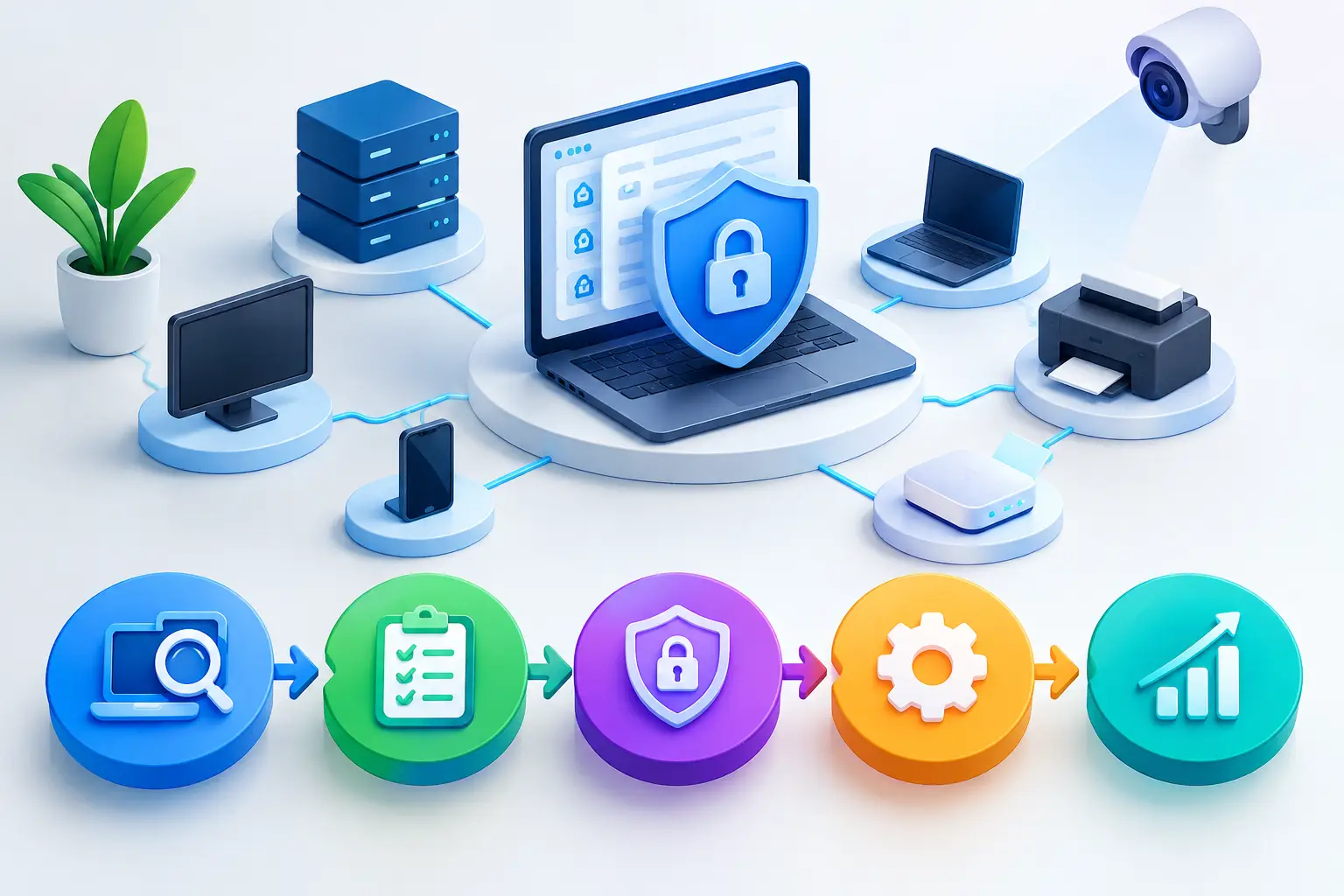
A practical process for building a trusted inventory
Start with the business services that matter most. Identify public websites, customer portals, email domains, payment systems, remote access services, core cloud platforms, and systems that store sensitive data. This provides a prioritized starting point instead of attempting to document every asset at once.
Next, gather records from existing sources. Endpoint management, cloud consoles, DNS providers, vulnerability scanners, firewall logs, identity platforms, procurement records, and service desks all contain partial inventory data. Compare those sources to identify gaps, duplicates, and systems with unclear ownership.
Then validate externally visible assets from an outside-in perspective. An organization may believe it has retired an old application or subdomain while DNS, hosting, or certificate records still expose evidence of it. External visibility should be reviewed separately from internal records because attackers use the public view, not the asset list your team intended to maintain.
Assign owners and classify the assets that create the greatest security and business impact. Do not wait for perfect data before beginning remediation. If an internet-facing system has no confirmed owner, that is itself a finding that should be tracked and resolved.
Finally, establish a review cadence. Critical external assets may need continuous monitoring, while lower-risk internal assets may be reviewed monthly or quarterly. The cadence should reflect how quickly the environment changes and how much harm an unmanaged asset could cause.
Common gaps that weaken inventory programs
Many inventories lose value because they are treated as a one-time cleanup project. The initial list may be accurate, but acquisitions, employee turnover, cloud experimentation, vendor changes, and application releases quickly make it stale.
Another frequent gap is confusing asset discovery with asset management. Discovery identifies potential assets. Management requires validation, ownership, classification, and a decision about whether an asset should remain active. An unknown server is not resolved merely because it appears on a dashboard.
Teams also need to account for assets outside traditional infrastructure. Domains, email-sending services, API endpoints, SaaS administrators, code repositories, and cloud identities may not look like servers, but they can carry significant security exposure. A complete program should include the systems that support business operations, not only the hardware in an office or data center.
FortifyNET approaches inventory as part of a broader security workflow: identify external and internal exposure, understand business impact, assign remediation actions, and maintain visibility as the environment changes. That discipline helps turn a static list into an operating control.
Make the inventory useful when it matters
The measure of an inventory is not how many records it contains. It is whether a responsible person can quickly answer a difficult question: What is exposed, who owns it, how important is it, and what must happen next?
When asset inventory tools are connected to continuous monitoring and a clear remediation process, security teams spend less time searching for context and more time reducing risk. That is the practical value of knowing your environment before someone else maps it for you.