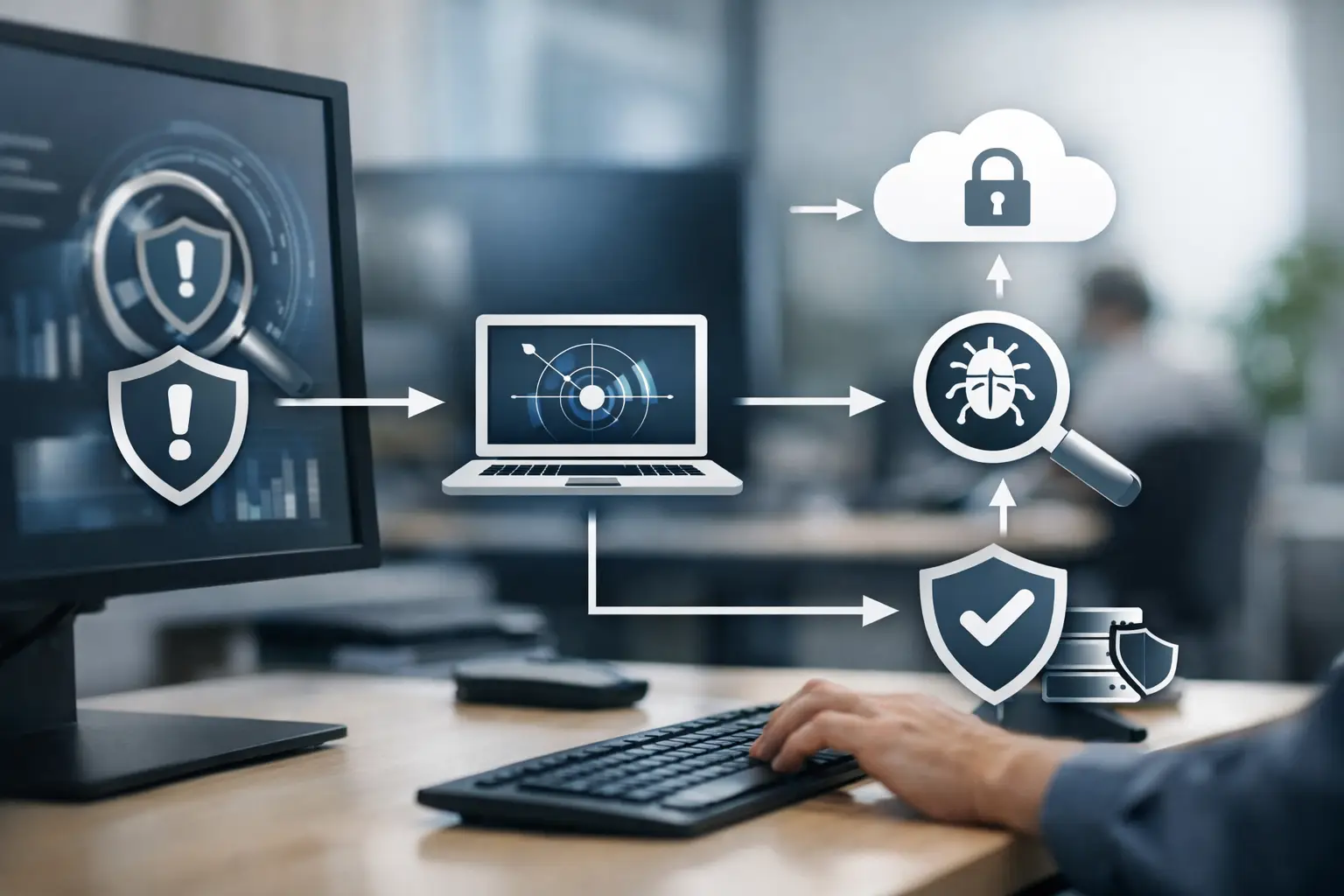
How Continuous Security Monitoring Tools Help
A vulnerability scan from last quarter will not tell you what changed this morning. A new subdomain went live, a certificate drifted toward expiration, an exposed service appeared on a public IP, or a mailbox rule was altered in a way no one intended. That is where continuous security monitoring tools matter. They give organizations an ongoing view of security conditions across web, network, domain, and email assets so teams can identify risk early, understand what changed, and remediate with better timing.
For small and mid-sized businesses, this is less about building a massive security operations center and more about creating dependable oversight. Most teams do not struggle because they lack concern. They struggle because their environment changes faster than periodic assessments can keep up. Continuous monitoring closes that gap by turning security from a one-time project into a managed process.
What continuous security monitoring tools actually do
Continuous security monitoring tools collect and review signals from your environment on an ongoing basis rather than at a fixed annual or quarterly interval. Depending on the platform, that may include external exposure scanning, website security checks, domain monitoring, compliance scanning, email oversight, certificate tracking, asset discovery, and alerting tied to defined risk conditions.
The practical value is visibility with context. A raw alert that says a port is open is not very useful by itself. An effective monitoring tool shows which asset is affected, whether the exposure is expected, how serious the risk is, what likely changed, and what action should come next. That difference matters to busy IT managers and operations leaders who need direction, not just noise.
This is also where many organizations misjudge the category. They assume monitoring means logs alone, or endpoint telemetry alone, or a SIEM deployment. Those can be part of the picture, but for many businesses the more immediate need is to continuously monitor the public-facing attack surface and core control areas that are most likely to create business risk. If your website, DNS, email, and internet-exposed infrastructure are changing week to week, external visibility is not optional.
Why periodic scans are no longer enough
A point-in-time assessment still has value. It can establish a baseline, support a compliance effort, or validate a major remediation project. But it has a shelf life. New assets appear. Configurations drift. Vendors introduce changes. Employees make administrative adjustments that seem harmless until they are not.
That creates a timing problem. If you only assess security every few months, the window between change and detection can be long enough for attackers to find the issue first. Continuous security monitoring tools shorten that window. They help teams move from discovering stale problems to catching active exposure while it is still manageable.
There is also a governance benefit. Leadership does not just need to know whether a scan was completed. They need to know whether exposure is improving, where repeat issues are appearing, and whether remediation is happening within a reasonable timeframe. Ongoing monitoring supports that kind of reporting far better than isolated assessments.
The most useful capabilities in continuous security monitoring tools
Not every business needs the same monitoring stack, so feature lists should be judged against actual exposure. Still, there are several capabilities that consistently matter.
Asset visibility is first. You cannot protect what you do not know you are exposing. Good tools help teams maintain awareness of domains, subdomains, certificates, externally reachable services, and web assets that may expand over time.
Change detection is next. Security issues often start as ordinary changes that were not reviewed carefully enough. Monitoring becomes far more useful when it can identify what is new, what drifted from policy, and what needs validation.
Risk prioritization is equally important. Many tools can generate findings. Fewer can separate a minor hygiene issue from a meaningful business risk. Prioritization should reflect exploitability, exposure, asset criticality, and likely impact so remediation efforts are directed where they matter most.
Actionable reporting is the capability that often determines whether a tool gets used well or ignored. Clear reports, defined severity, remediation guidance, and a centralized dashboard help technical and non-technical stakeholders stay aligned. This is especially important for organizations that need to show progress to leadership, auditors, or compliance teams.
Where businesses get the most value
The strongest use case for continuous monitoring is usually the external attack surface. Public-facing systems are the most accessible to attackers and the hardest to track through manual methods. A business may think it has a small footprint, then discover old test environments, forgotten subdomains, legacy services, or DNS records that are still reachable.
Email and domain oversight are another high-value area. Domain reputation, DNS health, certificate issues, spoofing exposure, and suspicious mailbox changes can quickly become security and business continuity problems. Monitoring these areas continuously helps reduce the chance that a misconfiguration or overlooked change turns into fraud, outage, or reputational damage.
Compliance-oriented monitoring also deserves attention, but with a caveat. Monitoring tools can support compliance readiness by checking for control gaps and generating recurring reports. They do not replace a full compliance program. The right expectation is that they help organizations maintain evidence, spot drift, and keep required controls visible between formal reviews.
What to look for before you choose a platform
Buyers often focus too heavily on feature quantity. A long list of checks does not automatically produce better security outcomes. The better question is whether the platform helps your team move from detection to remediation with enough clarity and consistency to improve posture over time.
Start with coverage. Does the tool monitor the assets you actually own and the risks you are most likely to face? A company with a large web presence may care most about web exposure, domain changes, and external services. Another may prioritize monitored email oversight and compliance reporting. Broad coverage is useful, but relevant coverage is what creates value.
Then look at signal quality. If every change creates an alert without meaningful context, the system becomes another dashboard people stop checking. Useful monitoring tools reduce noise by organizing findings, ranking severity, and showing what needs attention first.
Administrative control matters as well. Teams need clear user access, structured reporting, historical visibility, and a management interface that supports recurring review. Security monitoring only works when it becomes part of an operational rhythm. That requires more than scan output. It requires a system that supports ownership and follow-through.
Finally, consider whether expert guidance is part of the model. Many organizations can identify issues but struggle to plan remediation. A hybrid approach that combines platform monitoring with security consultation is often more effective than software alone, especially for smaller internal teams. FortifyNET reflects that model by pairing ongoing visibility with actionable remediation planning rather than leaving customers with a stack of unresolved alerts.
Common mistakes when using continuous security monitoring tools
One common mistake is treating monitoring as a replacement for security strategy. Monitoring shows what is happening, but it does not decide your priorities, define your risk tolerance, or fix weak internal processes. It should support governance, not stand in for it.
Another mistake is monitoring too narrowly. If a business only watches one layer, such as network exposure, it may miss domain, application, or email issues that create equal or greater risk. The right scope depends on your environment, but blind spots tend to form where ownership is unclear.
A third mistake is failing to assign response responsibility. Alerts without ownership are just documentation of future problems. Someone needs to review findings, validate severity, decide on remediation, and confirm closure. Without that workflow, even a strong tool underperforms.
Continuous monitoring is about control, not just detection
The real advantage of continuous security monitoring tools is not the alert itself. It is the control they create around a changing environment. They help businesses maintain visibility, document risk conditions, and respond before small issues become expensive incidents.
That matters whether you manage a handful of public assets or an expanding digital footprint across websites, domains, networks, and email systems. Security improves when monitoring is consistent, findings are understandable, and remediation is treated as an ongoing discipline. If your environment changes regularly, your security oversight should too.