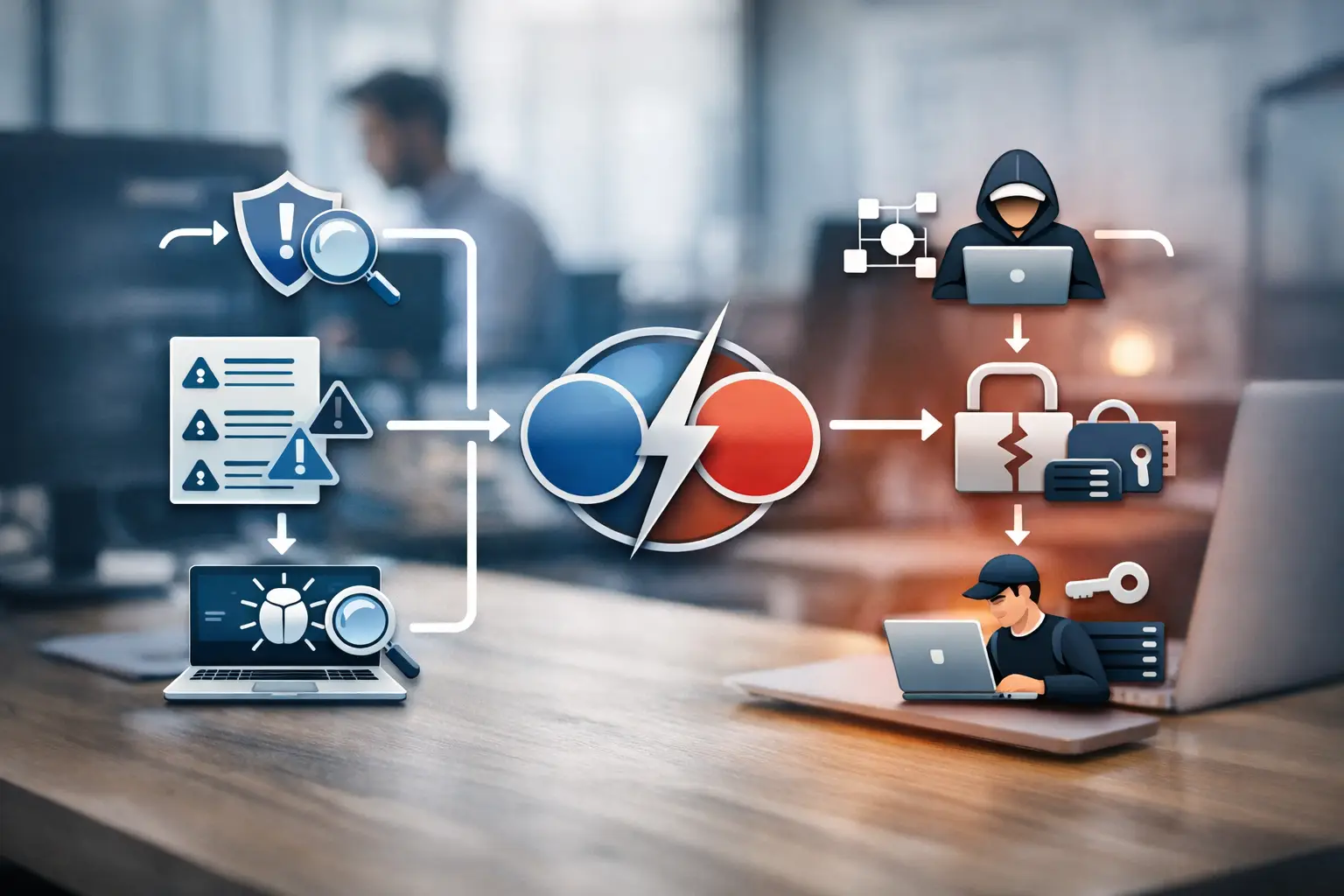
Vulnerability Scan vs Penetration Test Explained
A public-facing application, an aging VPN appliance, and an employee email domain can each create very different security risks. The vulnerability scan vs penetration test decision determines how clearly your organization can see those risks, how deeply they are investigated, and what action should follow. Both assessments support a stronger security posture, but they answer different questions and should not be treated as interchangeable.
For most small and mid-sized businesses, the practical answer is not to select one assessment forever. It is to use scanning for consistent visibility and penetration testing for focused validation where the risk, change, or business impact warrants it.
Vulnerability Scan vs Penetration Test: The Core Difference
A vulnerability scan identifies known weaknesses across systems, applications, networks, and public-facing assets. It uses automated checks to detect issues such as missing patches, outdated software versions, weak encryption settings, exposed services, insecure configurations, and known vulnerabilities associated with a specific technology.
A penetration test goes further. Authorized security professionals attempt to safely validate whether an attacker could exploit identified weaknesses and what access, data, or systems might be affected. The goal is not simply to produce a list of possible issues. It is to assess realistic attack paths and demonstrate the business impact of a successful compromise.
Put simply, a scan asks, “What may be vulnerable?” A penetration test asks, “Can this vulnerability be used, and how far could an attacker get?”
That distinction matters when resources are limited. A scan may identify hundreds of findings across your environment. A penetration test can show that one overlooked web application flaw allows access to customer records, while several higher-scoring technical findings have little practical exposure. Both perspectives are valuable, but they serve different operational decisions.
What a Vulnerability Scan Does Well
Vulnerability scanning is designed for breadth, repeatability, and ongoing oversight. It is particularly effective for organizations that need a current inventory of technical weaknesses across domains, web applications, cloud services, network devices, and internal systems.
Scans are usually automated and can run on a regular schedule. This makes them useful after software updates, infrastructure changes, new domain launches, configuration changes, and major security advisories. A well-managed scan program also helps teams track whether remediation work is reducing exposure over time.
The output typically includes severity ratings, affected assets, evidence of the issue, and remediation guidance. That gives IT and operations teams a workable starting point, especially when findings are organized by risk and ownership.
However, a scan has limitations. Automated tools can generate false positives, where a finding appears vulnerable but cannot actually be exploited in your environment. They can also lack the business context to determine whether a technically serious issue is isolated behind strong access controls or directly exposed to the internet. A scan identifies signals that require review. It does not always prove exploitability.
What a Penetration Test Does Well
A penetration test is a controlled security exercise performed within an agreed scope and set of rules. Testers may examine external systems, internal networks, web applications, cloud environments, wireless networks, or employee-focused attack scenarios, depending on the engagement.
Unlike an automated scan, a penetration test applies judgment. Testers chain together weaknesses, assess access controls, validate privilege escalation paths, and determine whether sensitive systems can be reached. They may confirm that a low-severity configuration issue becomes significant when combined with exposed credentials or an application authorization flaw.
The resulting report should explain more than the technical condition. It should document the attack path, affected business assets, evidence of successful validation, risk level, and prioritized remediation steps. That context is especially useful when leadership needs to decide whether an issue requires immediate action, additional monitoring, architectural changes, or a longer remediation project.
Penetration testing also has boundaries. It is a point-in-time assessment, not continuous protection. Its depth depends on the approved scope, available testing window, and whether testing is performed with or without credentials. A test cannot guarantee that every vulnerability has been found or that an attacker would never succeed through another route.
How the Assessments Differ in Practice
The difference becomes clearer when viewed through daily security operations. A vulnerability scan can cover a broad asset inventory regularly and efficiently. It helps identify new exposures before they become forgotten weaknesses. A penetration test concentrates skilled investigation on selected assets and high-value attack scenarios.
For example, a scan may flag a web server with an outdated component, an open management port, and a missing security header. A penetration tester may determine whether the component is reachable, whether the management interface can be accessed with weak authentication, and whether the missing header contributes to a meaningful browser-based attack. The tester may also find that none of these issues are exploitable due to network segmentation and compensating controls.
Neither result should be dismissed. The scan creates operational visibility. The test provides validation and context. Effective security programs use the scan findings to drive remediation and use penetration testing to examine the risks that could cause the greatest business disruption.
When Your Business Needs a Vulnerability Scan
Regular scanning is a practical baseline for nearly every organization with internet-facing assets or a growing technology footprint. It is especially valuable when your team needs continuous visibility but does not have dedicated security staff reviewing every system change.
A vulnerability scan is typically the right first step when you need to identify exposed assets, establish a remediation backlog, verify patch management, or monitor for newly disclosed vulnerabilities. It is also useful following acquisitions, infrastructure migrations, cloud configuration changes, or the launch of a new customer portal.
Frequency depends on the environment. A relatively stable small business network may benefit from monthly scans and immediate checks after meaningful changes. An organization operating customer-facing applications, handling sensitive data, or releasing software often may need more frequent scans and ongoing domain or exposure monitoring.
The value comes from what happens after the report. Findings should be reviewed, validated where needed, assigned to accountable owners, and tracked through remediation. Repeated scans should then confirm that fixes are effective and that new weaknesses have not been introduced.
When a Penetration Test Is Worth the Investment
A penetration test is appropriate when the potential impact of a compromise exceeds what an automated finding can explain. This is often the case before launching a new web application, after a significant architecture change, when integrating a third-party platform, or when protecting systems that process financial, personal, health, or proprietary information.
It is also a strong choice when a scan reveals critical or high-risk issues that require confirmation. Rather than treating every alert as an emergency, a focused test can establish whether a weakness is truly exploitable, what it exposes, and which remediation action will reduce risk fastest.
Many organizations also use penetration testing to support customer requirements, cyber insurance expectations, and compliance obligations. Requirements vary by industry and framework, so a test should be designed around the systems, controls, and evidence that matter to your organization. Checking a compliance box without defining a useful scope can produce a report that looks complete but leaves material risks unexamined.
Build a Program, Not a One-Time Assessment
The strongest approach is a clear operating sequence. Start with an accurate asset inventory, including domains, subdomains, web applications, network ranges, email systems, cloud services, and externally managed platforms. You cannot assess what you have not identified.
Use regular vulnerability scans to maintain visibility across that inventory. Prioritize findings based on more than a severity score: consider internet exposure, exploit availability, asset criticality, sensitive data access, and compensating controls. A critical issue on an isolated test server may require a different response than a high-severity flaw on a customer login page.
Then use penetration testing strategically. Focus it on high-value assets, major changes, suspicious exposure patterns, and scenarios where exploitability will change a business decision. The testing results should feed back into remediation planning, monitoring rules, and future scan priorities.
FortifyNET supports this discipline by pairing security analysis with actionable remediation planning and continuous monitoring, so findings do not disappear into a static report. Clear dashboards, documented outcomes, and recurring oversight help teams maintain control as their attack surface changes.
Avoid the Common Gaps
The most common failure is running a scan, receiving a long list of findings, and treating the report as the finished work. Discovery is only the beginning. Without validation, prioritization, ownership, deadlines, and retesting, even accurate findings will not materially reduce risk.
Another gap is relying on an annual penetration test as the entire security program. New vulnerabilities, cloud changes, expired certificates, exposed services, and configuration drift can appear long before the next scheduled engagement. Penetration testing is valuable, but it does not replace routine visibility.
Finally, avoid assuming a clean report means a clean environment. Scans have coverage limits, and penetration tests have scope limits. Security improves when assessment results are combined with patching, access control review, secure configuration standards, employee awareness, logging, and monitoring.
The right question is not whether a vulnerability scan or a penetration test is better. Ask what you need to identify now, what must be validated before it can harm the business, and how your team will verify that remediation lasts.