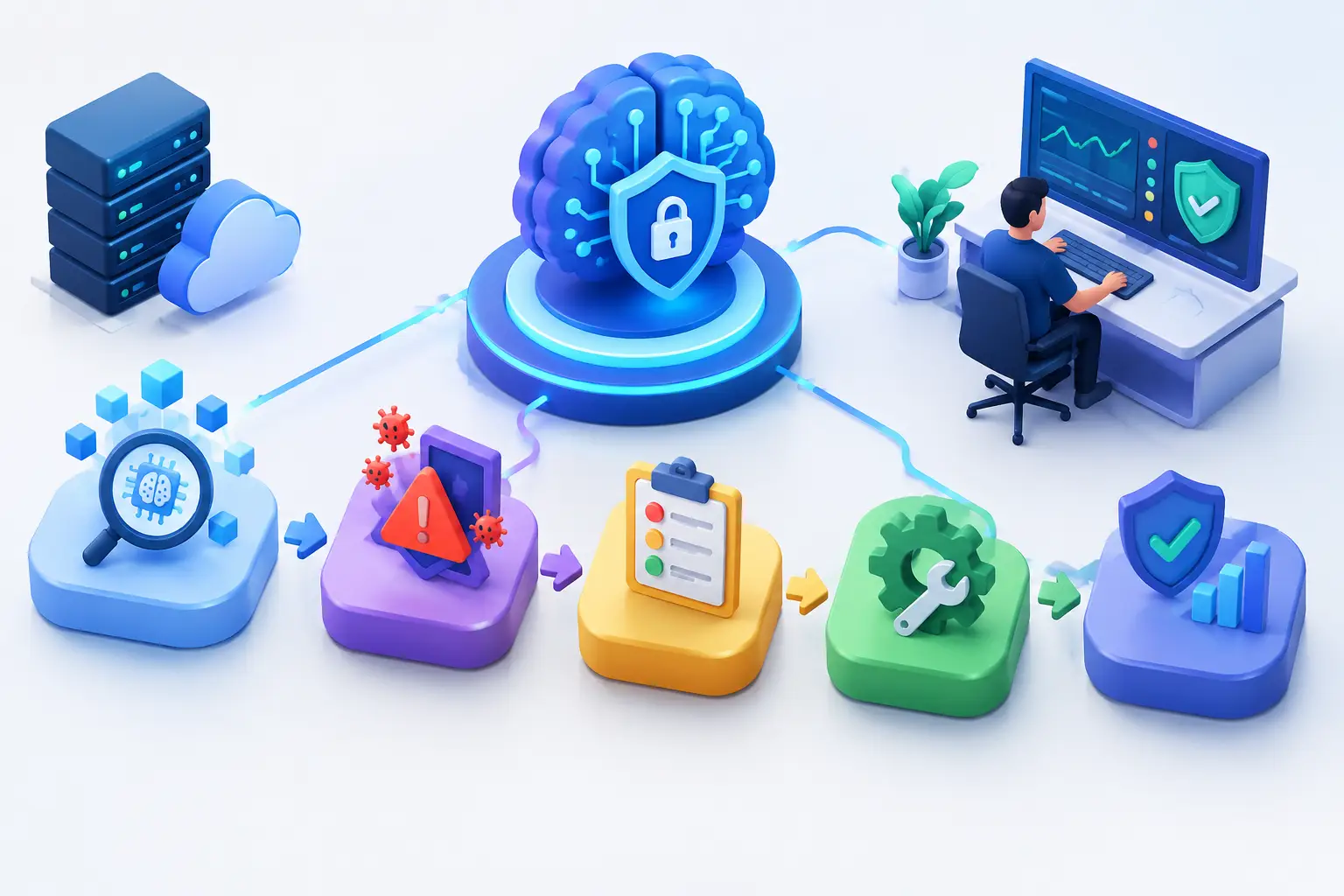
AI Vulnerability Management That Drives Action
A critical vulnerability alert is only useful if the right team can determine whether it affects a business asset, understand its likely impact, and act before it becomes an incident. AI vulnerability management can reduce the time between discovery and decision, but it does not replace security judgment. Its value comes from helping organizations turn a growing volume of findings into a disciplined remediation workflow.
For small and mid-sized businesses, this matters because the attack surface rarely stays still. New web applications, cloud services, domains, email platforms, employee devices, and third-party integrations can introduce exposure faster than a small IT team can review every alert. The challenge is not simply finding vulnerabilities. It is knowing which findings require immediate attention, which can be scheduled, and which are not relevant to the environment at all.
What AI Vulnerability Management Changes
Traditional vulnerability management relies on scanning, asset inventories, severity scores, analyst review, remediation, and retesting. These fundamentals remain necessary. AI adds value by processing large sets of technical and contextual data faster, identifying relationships that may otherwise be missed, and helping teams prioritize action.
For example, a scanner may report hundreds of known vulnerabilities across servers, applications, and network devices. A standard severity score can identify a technically serious issue, but it cannot always explain whether the affected system is internet-facing, contains customer data, supports a critical business process, or has compensating controls in place. AI can help correlate those details with asset ownership, exposure, known exploitation activity, past scan results, and remediation history.
The result should not be a longer list of alerts. It should be a shorter, clearer list of decisions: patch this public-facing system now, investigate this exposed service today, assign this internal finding to the next maintenance cycle, or validate that this apparent issue is not present.
Better prioritization, not automatic trust
AI models can group similar findings, summarize technical evidence, identify anomalous changes, and recommend likely remediation paths. That can be especially helpful when an organization has limited security staff or receives recurring reports from multiple tools.
However, an AI recommendation is not proof. It may rely on incomplete asset records, inaccurate scan data, or assumptions about how systems are connected. A recommendation to patch immediately may be correct from a security perspective but impractical during a business-critical operating window. Conversely, a finding labeled moderate may become urgent if it affects an exposed administrative portal.
Effective programs treat AI as an acceleration layer. Security teams and accountable administrators still validate scope, business impact, remediation risk, and completion.
The Data Behind Useful AI Decisions
AI is only as useful as the information it can evaluate. If an organization does not know which domains, applications, IP addresses, cloud accounts, email systems, and network assets it owns, prioritization will remain unreliable.
A strong foundation begins with a current asset inventory. Each asset should have an owner, a business function, a classification for sensitivity, and an indication of whether it is publicly accessible. This context allows vulnerability findings to be evaluated against real operational risk instead of technical severity alone.
Scan data also needs quality control. Duplicate assets, stale DNS records, retired systems, and unverified findings create noise. Continuous domain monitoring and exposure scanning help identify changes that annual assessments can miss, including newly exposed services, expired certificates, unauthorized subdomains, and configuration drift.
Threat context is another important input. A vulnerability with public exploit code or confirmed active exploitation deserves more attention than an equally scored issue with no practical attack path. AI can assist by reviewing threat intelligence at scale, but the organization must define its own risk thresholds. A healthcare provider, financial services firm, and e-commerce business may all prioritize the same technical weakness differently based on their data, regulatory obligations, and tolerance for downtime.
Where AI Helps Most in the Remediation Workflow
The strongest use cases are practical and repeatable. AI can reduce manual effort at several points in the vulnerability lifecycle without removing accountability from the process.
Asset and exposure correlation
Security teams often have information spread across scanning tools, cloud consoles, domain records, ticketing platforms, and spreadsheets. AI can help correlate an exposed host with the application it supports, the owner responsible for it, and related findings that may indicate a broader configuration issue.
This is particularly useful for public-facing web assets. A forgotten staging site, old administrative interface, or misconfigured cloud service can create more immediate risk than a large number of lower-priority internal findings. Identifying that exposure quickly gives teams a more defensible starting point.
Finding triage and remediation guidance
Many vulnerability reports contain technical descriptions that are accurate but not operationally useful for a business owner or busy administrator. AI can translate scanner output into clear remediation tasks, such as updating a vulnerable component, restricting an exposed port, correcting a DNS record, enforcing multifactor authentication, or removing an unused service.
The best guidance includes evidence, affected assets, the reason for the priority level, an assigned owner, a target completion date, and a validation step. A recommendation without a documented path to resolution is still only an alert.
Detecting patterns and recurring weaknesses
Repeated findings often reveal process problems rather than isolated technical mistakes. If similar certificate, patching, email authentication, or access-control issues appear across several assets, the organization may need a baseline configuration standard or a more reliable change-management process.
AI can identify these patterns across reports and monitoring data. That supports more strategic decisions, such as standardizing a secure deployment template or adjusting a maintenance schedule, rather than repeatedly correcting the same issue one system at a time.
Risks to Manage Before Adding AI
AI introduces its own security and governance concerns. Organizations should not send sensitive vulnerability reports, architecture details, credentials, customer information, or internal logs to an AI service without understanding how that data is handled, retained, and protected.
Access control matters as well. An AI-enabled platform should follow least-privilege principles, maintain audit trails, and separate user roles. Not every administrator needs visibility into every asset, report, or remediation plan. Monitoring data can reveal valuable information about infrastructure and business operations, making it a target in its own right.
There is also a risk of false confidence. An automated summary can sound authoritative even when the underlying information is incomplete. Teams should retain source evidence, review material recommendations, and require verification before closing critical findings. Remediation should be confirmed through rescanning, configuration checks, or other documented validation methods.
Building a Program That Produces Measurable Progress
A useful AI-enabled vulnerability management program starts with defined operating rules. Establish how assets are discovered and approved, how findings are scored, who owns remediation, when exceptions are allowed, and how completion is verified. These rules give AI-generated insights a consistent place in the workflow.
Reporting should show more than the number of vulnerabilities found. Leadership and compliance stakeholders need visibility into internet-facing exposure, overdue critical findings, remediation time by severity, recurring control failures, and trends across business units. These measures demonstrate whether risk is actually declining.
FortifyNET approaches this work as an ongoing discipline: identify exposed assets, understand the practical impact of findings, create an actionable remediation plan, and maintain visibility through continuous monitoring and structured reporting. That combination is more useful than an isolated scan because it connects technical evidence to accountable action.
AI can make vulnerability management faster and more focused, particularly when the volume of findings exceeds a team’s review capacity. But the organizations that gain the most value will keep the process grounded in accurate asset data, clear ownership, human validation, and continuous follow-through. Every resolved finding should strengthen not only one system, but the organization’s ability to prevent the same exposure from returning.