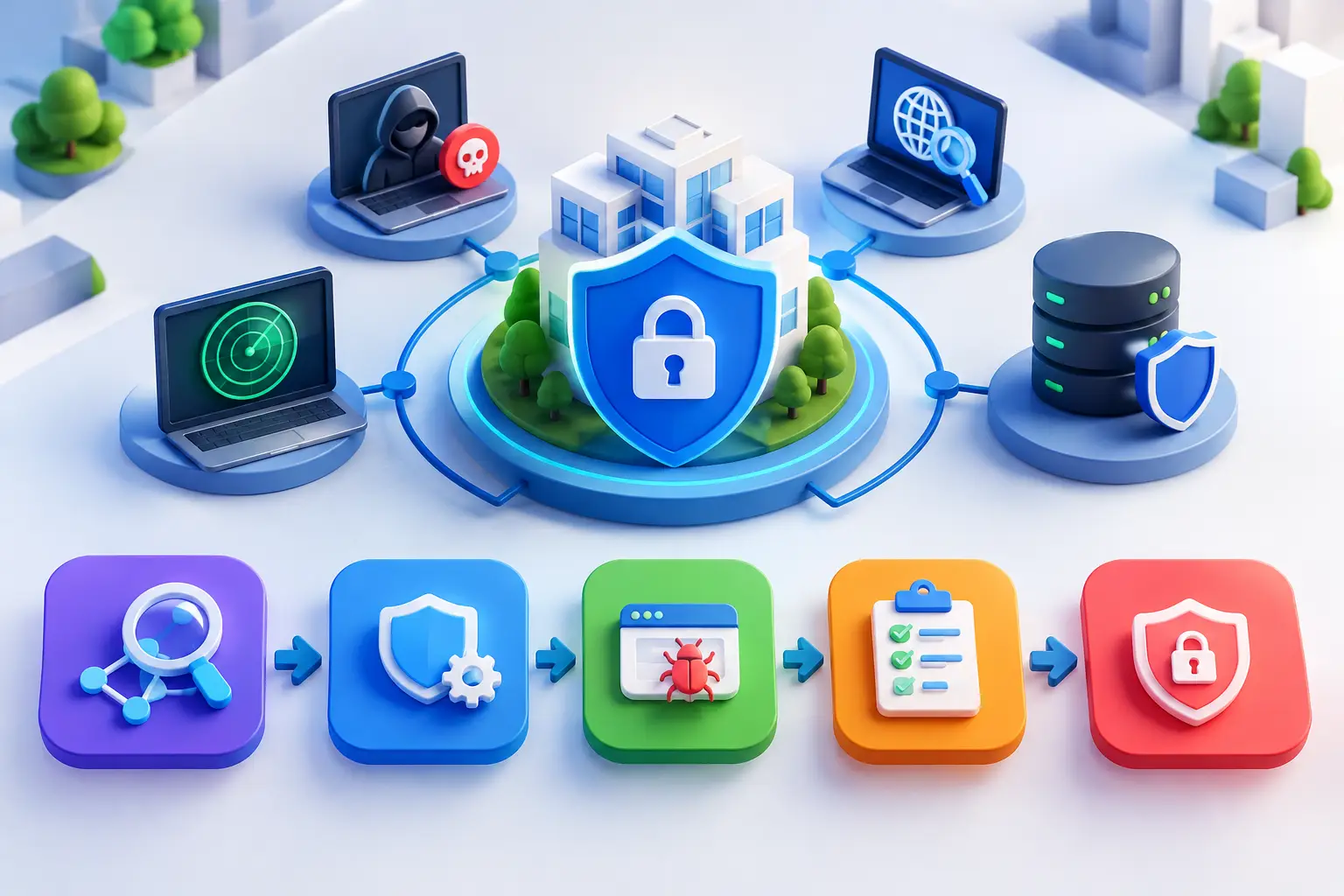
Best Attack Surface Tools for Business Security
A forgotten subdomain, an expired cloud test environment, or an exposed email service can become an entry point long before it appears on an internal asset inventory. The best attack surface tools help businesses find these overlooked assets from an outside-in perspective, understand which exposures matter, and assign remediation work before attackers find an opportunity.
For small and mid-sized organizations, the decision is not simply about buying another scanner. It is about building a reliable process for discovering internet-facing assets, validating ownership, prioritizing real risk, and tracking remediation over time. The right platform should support that process without leaving IT teams buried in alerts they cannot act on.
What attack surface tools are designed to find
Attack surface management tools continuously map the systems an organization exposes to the internet. That can include domains and subdomains, IP addresses, web applications, cloud-hosted services, public storage, exposed remote access portals, certificates, DNS records, email infrastructure, and third-party services connected to the business.
This differs from a traditional vulnerability scanner. A vulnerability scanner is most effective when you already know what assets you own and can authorize it to inspect. Attack surface management begins with a different question: what can an external party identify as part of your organization?
That distinction matters when business growth has outpaced documentation. A marketing team may launch a campaign site through a vendor. A developer may leave a staging environment online. An acquired business may retain domains that are no longer actively managed. Each asset can expand exposure even if it never appears in a central IT inventory.
Strong tools also provide context. Finding an open port is useful, but security teams need to know whether it is tied to a production system, whether a known exploit exists, whether sensitive data may be exposed, and who can resolve it. Discovery without ownership and prioritization creates another queue. Effective attack surface management creates a remediation plan.
Best attack surface tools by use case
No single product is the best fit for every organization. Some platforms are strongest at broad internet discovery, while others fit companies already invested in a specific endpoint, cloud, or security operations ecosystem. The best choice depends on the complexity of your public footprint and the team responsible for remediation.
| Tool | Best fit | Primary strength | Consideration | | --- | --- | --- | --- | | Microsoft Defender External Attack Surface Management | Organizations using Microsoft security tools | Asset discovery and integration with the Microsoft ecosystem | Value depends on existing Microsoft investment and workflow maturity | | CrowdStrike Falcon Exposure Management | Teams using CrowdStrike for endpoint security | Exposure context across assets, identities, and endpoints | May be more platform than a smaller team needs for external discovery alone | | Palo Alto Networks Cortex Xpanse | Enterprises with large, changing internet footprints | Continuous discovery and identification of unmanaged assets | Requires disciplined ownership processes to turn findings into closure | | CyCognito | Organizations seeking external asset discovery with guided prioritization | Automated discovery and business-risk context | Teams should validate asset attribution before escalating findings | | Censys | Security teams conducting detailed internet intelligence and investigations | Deep visibility into hosts, certificates, and exposed services | Often requires analyst skill and defined workflows for operational use | | Shodan | Technical teams performing targeted external reconnaissance | Fast visibility into exposed services and technologies | Best used as a research capability, not a complete remediation program |
Microsoft Defender External Attack Surface Management
Microsoft Defender EASM is a practical option for businesses already using Microsoft Defender, Microsoft 365, or Azure. It can identify external assets and help teams relate discoveries to broader security operations. For IT managers who want fewer disconnected consoles, ecosystem integration can be a meaningful advantage.
Its value increases when the organization has established asset owners and ticketing processes. Otherwise, it can accurately reveal exposure while the business still struggles to decide who owns an old domain or public application.
CrowdStrike Falcon Exposure Management
CrowdStrike Falcon Exposure Management is suited to organizations that want exposure management connected to endpoint security and threat intelligence. It can help teams understand how external exposure, endpoint weaknesses, and identity-related risk combine.
This can be especially useful when a business needs security operations to work from a shared risk picture. The trade-off is scope and cost. A smaller organization focused primarily on domains, web applications, and email configuration may need a more targeted service model rather than a broad enterprise security platform.
Palo Alto Networks Cortex Xpanse
Cortex Xpanse is built for continuous, large-scale discovery of internet-facing assets. It is particularly relevant for organizations with decentralized teams, multiple cloud accounts, acquisitions, or a history of unmanaged infrastructure.
Its strength is finding what conventional inventories miss. However, detection is only the first stage. Businesses still need a clear method for confirming ownership, documenting business purpose, removing obsolete assets, and verifying that corrective actions were completed.
CyCognito
CyCognito focuses on discovering assets from an attacker’s perspective and assigning business context to exposures. It is often a good fit for companies that know their asset inventory is incomplete and need help moving from discovery to prioritized action.
As with any external discovery platform, attribution requires review. A tool may identify infrastructure that appears connected to your organization but belongs to a vendor, affiliate, or unrelated entity. Security teams should have a defined validation step before opening urgent remediation tickets.
Censys and Shodan
Censys and Shodan are valuable tools for technical security teams, consultants, and incident responders. They provide visibility into internet-exposed systems, certificates, technologies, and services. They are useful for validating a suspected exposure, researching a domain footprint, or investigating whether a service is publicly accessible.
They are not, by themselves, a complete attack surface management program. Most businesses need continuous monitoring, asset ownership records, risk scoring, reporting, and remediation tracking. These tools can strengthen that program, but they do not replace it.
How to evaluate the best attack surface tools
Start with coverage. A platform should look beyond primary domains and known IP ranges. Ask whether it discovers subdomains, DNS changes, TLS certificates, cloud assets, exposed services, email security records, and public web technologies. If your business relies heavily on SaaS vendors, ask how it identifies third-party exposure and distinguishes it from assets you directly control.
Next, examine prioritization. A long list of CVEs is not a risk program. Look for tools that consider internet reachability, exploitability, asset criticality, sensitive data exposure, and signs of active threat activity. The output should help an IT manager answer a direct question: what must be fixed first, by whom, and why?
Ownership and workflow matter just as much. The platform should allow teams to classify an asset as owned, unowned, third-party, retired, or under investigation. It should retain a record of findings, remediation status, due dates, and verification. This is particularly important for compliance stakeholders who need documented evidence that findings were reviewed and addressed.
Finally, evaluate reporting. Executives need a clear view of material exposure, remediation trends, and unresolved risk. Technical teams need enough detail to reproduce and correct a finding. A useful solution serves both audiences without forcing them to interpret the same raw alert feed.
Continuous monitoring is the deciding factor
A one-time external scan is valuable, but it is only a snapshot. New domains are registered, cloud resources are deployed, certificates are renewed, vendors change configurations, and employees create services outside formal approval processes. The attack surface changes whenever the business changes.
Continuous monitoring provides the operational advantage. It can identify a newly exposed service, alert teams when a domain’s configuration changes, and show whether a previously remediated issue has returned. It also establishes accountability: findings are not merely delivered in a report, but monitored through closure.
This is where a consultative model can be more effective than software alone. FortifyNET combines exposure visibility with security analysis, actionable remediation planning, and recurring oversight so businesses can move from finding vulnerabilities to managing them as an ongoing discipline.
Build a process around the tool
Before selecting a platform, define who reviews new discoveries, who validates ownership, who remediates each class of issue, and when leadership receives status reports. A tool cannot resolve uncertainty between IT, development, marketing, and outside vendors. It can make that uncertainty visible quickly.
The most useful deployment begins with a baseline assessment of domains, applications, network services, cloud resources, and email infrastructure. Teams should then remove assets that are no longer needed, correct high-risk misconfigurations, and establish monitoring rules for changes that require review. Over time, the attack surface inventory becomes more accurate because it is maintained through real operating workflows.
The best attack surface tools are not the ones that generate the most discoveries. They are the ones that give your organization a defensible view of exposure, a practical path to remediation, and enough continuous oversight to keep yesterday’s fix from becoming tomorrow’s incident.