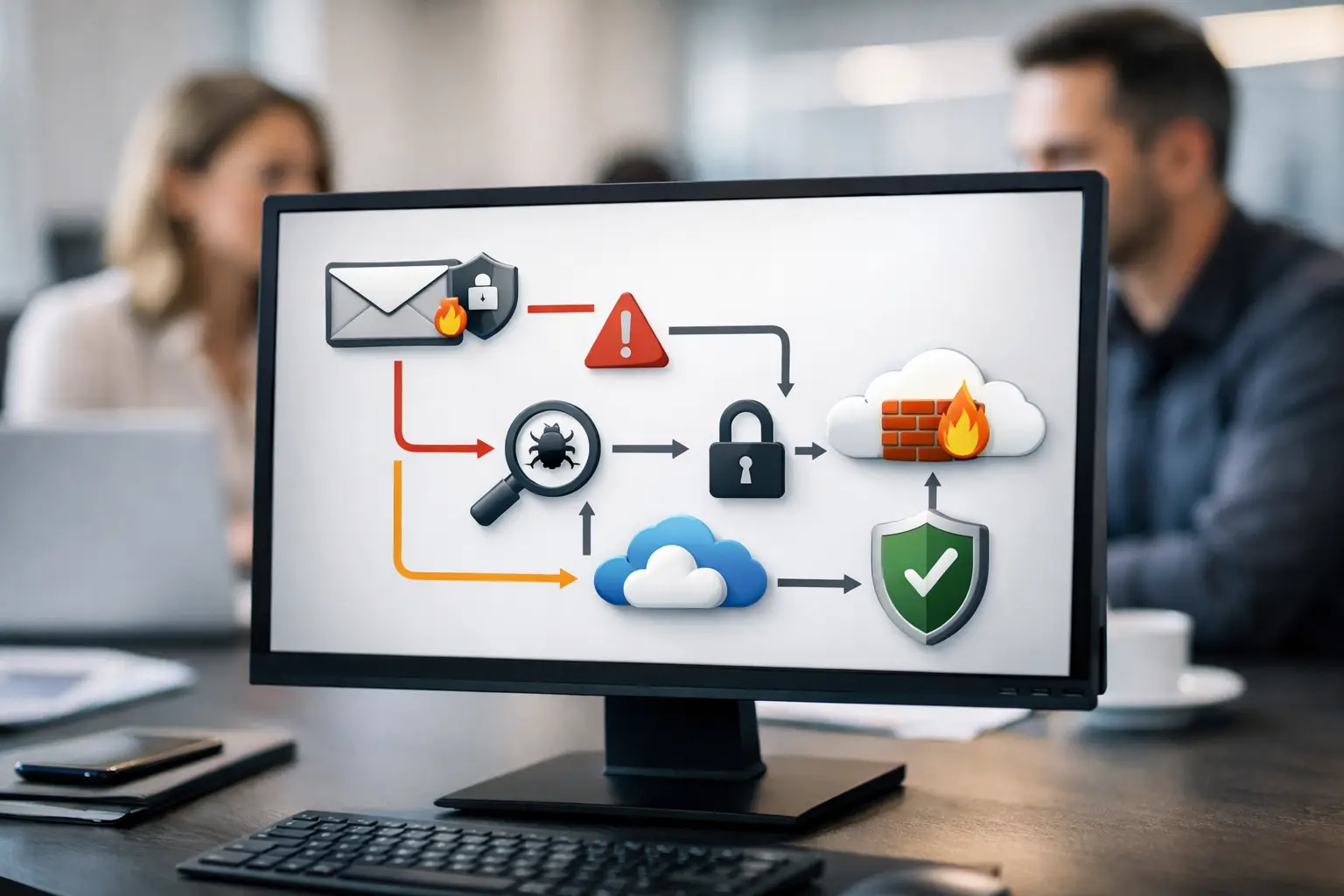
Business Email Security Monitoring That Works
A finance lead approves a wire transfer, a customer gets a fake invoice that looks legitimate, or a domain starts sending mail your team never authorized. By the time someone notices, the damage is already operational, financial, and reputational. That is why business email security monitoring matters. It gives organizations ongoing visibility into how their domains, mail systems, and email-related controls are being used, abused, and exposed.
For many small and mid-sized businesses, email security is still treated as a setup task. SPF gets added, DKIM is configured, maybe DMARC is published, and the work is considered done. That approach leaves a gap. Email environments change constantly. Vendors send on your behalf, new subdomains appear, staff roles shift, forwarding rules get created, and threat actors keep testing what they can spoof or compromise. Monitoring is what turns a static configuration into an active security function.
What business email security monitoring actually covers
Business email security monitoring is broader than spam filtering or inbox malware detection. Those controls matter, but they address only part of the problem. Monitoring focuses on the health, behavior, and trustworthiness of your email ecosystem over time.
That includes watching domain authentication records such as SPF, DKIM, and DMARC; validating whether authorized senders align with policy; identifying spoofing attempts; spotting unusual mail activity; and tracking changes that could weaken protection. In practical terms, the goal is simple: know who can send as your business, know whether email authentication is working as intended, and know when something changes before it turns into fraud or deliverability damage.
This is also where many teams discover that email risk is tied to broader operational issues. A marketing platform may be sending from a domain that was never fully approved. A former vendor may still be listed in SPF. An executive account may have forwarding behavior that deserves review. Monitoring brings these details into view and gives administrators a basis for action.
Why email monitoring fails when it is treated as a one-time project
The common failure point is not lack of tools. It is lack of continuity. Email security is often implemented during a migration, compliance review, or incident response effort, then left without routine oversight.
That creates blind spots. A record that was correct six months ago may be too permissive today. A DMARC policy may exist, but reporting may not be reviewed. A mailbox may remain protected on paper while real-world sending patterns show policy drift. Security teams and administrators need more than configuration snapshots. They need monitored signals, exception tracking, and reports that connect findings to remediation.
This is especially important for organizations with lean IT teams. If the same people managing devices, licenses, help desk tickets, and vendor onboarding are also expected to police email infrastructure manually, important signals will be missed. Monitoring reduces that burden by organizing visibility into an operational workflow rather than leaving it to ad hoc checks.
The controls that deserve continuous attention
A secure email posture starts with basic technical controls, but business email security monitoring is what confirms they remain effective.
SPF, DKIM, and DMARC need validation, not just deployment
SPF helps define which systems can send email for your domain. DKIM adds a cryptographic signature to validate message integrity. DMARC tells receiving servers how to handle mail that fails alignment checks and provides reporting insight. These three are foundational, but they are also easy to mismanage over time.
SPF can become bloated or overly broad as services are added. DKIM keys can be misconfigured or inconsistently applied across platforms. DMARC can be published at a weak policy level and never advanced. Monitoring helps identify whether these controls are operating correctly, whether legitimate senders are aligned, and whether suspicious sources are trying to impersonate your domain.
Domain and subdomain activity often creates hidden risk
Many businesses focus on their primary domain and ignore subdomains used for campaigns, support, regional operations, or legacy systems. Attackers do not make that distinction. If a subdomain is weakly governed, it can become a path for impersonation or reputational harm.
Ongoing oversight should account for both primary domains and the broader namespace tied to your business. That includes checking whether new sending sources appear, whether records change without review, and whether separate business functions are using email in ways that bypass central policy.
Account-level behavior still matters
Domain protection does not eliminate user risk. Compromised credentials, suspicious login patterns, unauthorized forwarding rules, and misuse of privileged mailboxes remain common causes of business email compromise. Depending on the environment, account behavior monitoring may sit partly inside your email platform and partly within your broader security stack.
The trade-off here is scope. Some organizations need deep mailbox telemetry and identity monitoring, while others first need basic domain-level visibility because they do not yet know what is sending as their brand. The right starting point depends on maturity, staffing, and risk exposure.
What good monitoring looks like in practice
The strongest programs do not flood teams with raw reports. They translate email risk into clear operational decisions.
A practical monitoring approach should show which senders are authorized, which are failing alignment, and which require review. It should surface policy changes, suspicious authentication failures, and trends that suggest abuse or misconfiguration. Just as important, it should separate noise from action. Not every failed message is a threat, and not every configuration issue deserves the same urgency.
This is where a dashboard-backed process becomes valuable. Security findings need context, ownership, and a path to remediation. If an external service is sending without proper alignment, someone should know whether to authorize it, reconfigure it, or remove it. If spoofing attempts spike, the organization should be able to assess whether stricter DMARC enforcement or additional domain controls are warranted. Visibility only matters when it leads to a managed response.
Common gaps small and mid-sized businesses should address first
Most organizations do not need to start with the most advanced email threat analytics. They need to close the obvious gaps that create repeated exposure.
One common issue is incomplete sender inventory. Businesses often do not have a reliable record of every platform, vendor, or department authorized to send email using the company domain. Without that inventory, SPF and DKIM become guesswork, and DMARC enforcement becomes risky because legitimate mail may break.
Another issue is passive DMARC use. Publishing a policy at p=none can be a sensible first step, but staying there indefinitely limits protection. Monitoring helps organizations understand what legitimate traffic exists so they can move toward stronger enforcement with fewer surprises.
There is also the reporting gap. Technical data may exist, but it is not being reviewed in a way that helps leadership or administrators make decisions. Good monitoring closes that gap with structured reports that show current posture, notable changes, unresolved weaknesses, and next remediation steps.
Monitoring should support compliance and governance, not just threat detection
Email security has operational and regulatory implications. For organizations dealing with client data, payment workflows, internal approvals, or contractual obligations, weak email controls can quickly become a governance issue.
Continuous monitoring supports documentation. It shows that controls are not only configured but also reviewed, maintained, and improved over time. That matters for internal accountability and for external expectations tied to audits, customer security reviews, or sector-specific compliance requirements.
It also gives leadership something they often lack: a usable security record. Instead of relying on assumptions that email is "handled," they can see whether controls are active, whether risk is increasing or decreasing, and where remediation efforts should be prioritized.
How to choose the right monitoring model
There is no single model that fits every business. A company with one domain and a simple Microsoft 365 setup has different needs than a multi-brand organization using several sending platforms and managing high volumes of external communication.
What matters is whether the monitoring model provides ongoing visibility, actionable reporting, and administrative control. If the output is too technical, teams will ignore it. If it is too shallow, meaningful issues will be missed. The best fit usually combines automated oversight with expert review so findings are interpreted correctly and remediation is guided, not guessed.
That is the real value of a platform-and-advisory approach. Tools can surface signals, but businesses still need help understanding what changed, why it matters, and what to do next. For organizations that do not have dedicated in-house email security specialists, that structure is often more realistic than trying to build a fully manual review process around scattered logs and alerts.
FortifyNET approaches this as an ongoing security discipline rather than a one-time technical checklist. That distinction matters because email risk does not stay still.
Business email is still one of the fastest ways for attackers to impersonate trust, intercept processes, and create expensive confusion. Monitoring gives you a chance to catch warning signs earlier, tighten controls with confidence, and keep email aligned with the way your business actually operates. The most effective move is not waiting for the next suspicious message. It is building visibility before you need to explain what happened.