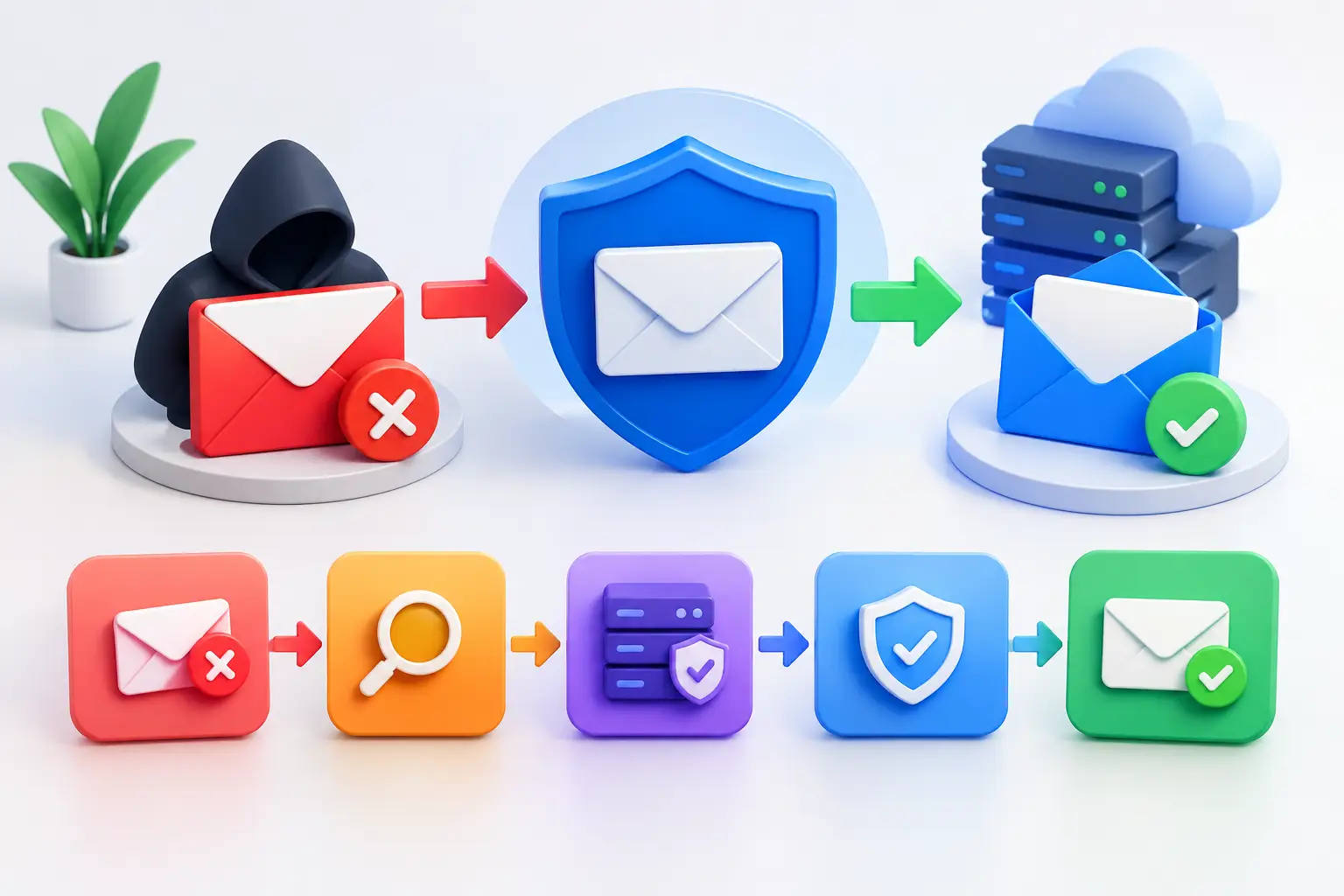
DMARC Spoofing Prevention for Business Email
A fraudulent invoice does not need to breach your network to cause damage. If it arrives from an address that appears to use your company’s domain, a customer, vendor, or employee may trust it before anyone has time to investigate. DMARC spoofing prevention gives organizations a practical way to stop unauthorized senders from using their domain in the From field and to gain visibility into who is attempting it.
For small and mid-sized businesses, the objective is not simply to publish another DNS record. It is to establish control over every legitimate system that sends email on the organization’s behalf, enforce a defensible policy, and continuously monitor for changes that create exposure.
Why email domain spoofing remains a business risk
Email is still one of the most effective delivery channels for fraud. Attackers commonly impersonate executive addresses, billing teams, support desks, and vendor relationships to request payments, redirect bank details, distribute malware, or harvest credentials. Even when an attacker does not gain access to a mailbox, domain impersonation can harm customer trust and create costly incident response work.
Traditional spam filtering helps recipients identify suspicious messages, but it does not prove that an email claiming to be from your domain was authorized by your organization. That distinction matters. Your business needs a control that tells receiving mail systems what to do when authentication fails.
DMARC, or Domain-based Message Authentication, Reporting, and Conformance, provides that control. It builds on SPF and DKIM, then checks whether the authenticated domain aligns with the domain visible to the recipient in the From address. When alignment fails, DMARC tells the recipient server whether to accept, quarantine, or reject the message.
How DMARC spoofing prevention works
Effective DMARC spoofing prevention depends on three connected technologies. SPF identifies which mail servers are authorized to send mail for a domain. DKIM adds a cryptographic signature that receiving servers can validate. DMARC evaluates these signals and requires alignment with the visible From domain.
Alignment is where many organizations find the real value. An email may pass SPF for a third-party sending platform, yet still fail DMARC if that platform authenticates a different domain than the one customers see. Similarly, a DKIM signature can be valid but not aligned if it is signed by an unrelated domain. DMARC requires at least one aligned authentication path to pass.
A DMARC record also includes a policy. The policy determines how receiving systems should handle failing messages:
- `p=none` requests reporting without asking recipients to block mail.
- `p=quarantine` asks receiving systems to treat failed mail as suspicious, often placing it in spam or quarantine.
- `p=reject` asks receiving systems to refuse failed mail outright.
- `pct=` allows a policy to apply to only a percentage of failing mail during a phased rollout.
The goal is generally to reach `p=reject` for the organizational domain and relevant subdomains. However, moving to rejection before legitimate senders are identified can block valid mail. A controlled rollout is more reliable than a rushed enforcement decision.
Start with a complete sending inventory
The most common DMARC deployment problem is not a syntax error. It is an incomplete inventory of services that send email using the company domain. Marketing platforms, help desk tools, accounting systems, customer relationship management platforms, website forms, cloud productivity suites, and managed service providers may all send on your behalf.
Begin by identifying every domain and subdomain used in visible From addresses. Include inactive domains that may still be recognizable to customers, because attackers often target abandoned or lightly managed assets. Then document each legitimate sending source, the business owner, the volume of mail it sends, and whether it supports aligned SPF or DKIM.
This work should involve more than IT. Finance may use a billing platform that IT does not administer. Marketing may operate a campaign tool through an agency account. Customer support may use a ticketing provider configured years ago. A complete inventory turns DMARC from a DNS exercise into an operational security control.
Configure SPF and DKIM for alignment
Once sending sources are known, configure SPF and DKIM according to each provider’s documented requirements. SPF records must remain within the DNS lookup limit, so repeatedly adding third-party includes without review can cause authorization failures. Consolidate unnecessary services and remove obsolete entries rather than treating SPF as a permanent accumulation of vendors.
DKIM is often the more dependable alignment path because it is less affected by mail forwarding. Each authorized platform should sign mail with a DKIM domain that aligns with the From domain whenever possible. Use strong keys, rotate them on a planned schedule, and confirm that signatures remain valid after platform changes.
Organizations should also decide how strictly to apply alignment. Relaxed alignment accommodates related subdomains, while strict alignment requires an exact domain match. Relaxed alignment is a sensible starting point for many businesses with complex email environments. Strict alignment may provide additional assurance, but only after testing confirms it will not interrupt legitimate mail flows.
Use reporting to validate before enforcement
DMARC aggregate reports show which systems are sending mail that claims to be from your domain, whether SPF and DKIM passed, and whether those results aligned. These reports are essential during deployment, but raw XML files are not practical for most teams to review manually. They should be processed into a dashboard or structured reporting workflow that highlights unauthorized sources, authentication failures, and trends over time.
Start with a `p=none` policy while you validate authorized senders. This does not prevent spoofing on its own, but it creates the visibility needed to remediate configuration gaps safely. Review reporting for several weeks, including normal business cycles such as invoicing runs, marketing sends, and seasonal campaigns.
Do not assume every unknown source is malicious. A legitimate vendor may be using a legacy configuration, or a department may have adopted a tool outside standard procurement. Investigate the source, confirm ownership, and either authenticate it correctly or stop it from sending as your domain. The same process often reveals shadow IT and outdated vendor relationships that deserve broader review.
Move to enforcement in controlled stages
After legitimate traffic is consistently passing DMARC, move from monitoring to enforcement. Many organizations begin with `p=quarantine` and a limited percentage through the `pct` tag. This creates a measured test of how major receiving providers handle failing messages while limiting the risk of widespread delivery disruption.
As reports show that valid mail continues to pass, increase the percentage and then move to `p=reject`. Enforcement should be treated as a change-management activity. Record the policy change, notify system owners, establish a rollback process, and assign responsibility for reviewing delivery issues.
Subdomain policy also deserves attention. Attackers may use subdomains when the primary domain is protected but related names are not. A `sp` tag can define a policy for subdomains, although organizations that actively send from subdomains should validate those mail streams separately before applying rejection.
Keep DMARC under continuous oversight
DMARC can degrade after a successful implementation. A new marketing provider may be added without aligned authentication. A vendor may change its delivery infrastructure. A DKIM key can expire, a domain can be acquired, or an administrator can modify DNS records during an unrelated project.
Continuous monitoring is therefore part of the control, not an optional add-on. Establish a regular review cadence for DMARC reports, SPF records, DKIM selectors, and domain inventory. Security teams should also monitor lookalike domains and public-facing assets, since attackers may combine domain spoofing with visually similar addresses to bypass recipient awareness.
FortifyNET approaches email protection as part of a broader exposure management process: identify the asset, understand the risk, remediate the weakness, and maintain visibility after the initial fix. DMARC reporting is most useful when it feeds that same disciplined workflow, with clear owners, documented actions, and evidence that controls remain effective.
Measure the outcome, not just the policy
A published DMARC record is not the outcome. The meaningful measures are the percentage of legitimate mail passing aligned authentication, the number of unauthorized sending sources removed or remediated, the status of enforcement across domains and subdomains, and the time required to detect a configuration change.
There are trade-offs. A strict reject policy provides stronger protection, but it demands better governance over email-sending systems. A relaxed policy is easier to operate, but it may leave room for inconsistent configurations. The right path depends on the number of sending platforms, the sensitivity of your communications, and the organization’s ability to manage change.
The practical next step is to treat your email domain as a protected business asset. Assign ownership, establish reporting, and make authentication review part of every new vendor and campaign launch. That discipline gives customers and partners a stronger reason to trust the messages that carry your name.