How Often Should You Scan External Assets?
A newly exposed subdomain, an expired certificate, or a forgotten cloud service can create risk long before a scheduled annual assessment finds it. When business leaders ask how often to scan external assets, the right answer is not simply “once a month” or “once a quarter.” The appropriate frequency depends on how quickly your environment changes, what data your systems handle, and how visible those systems are to attackers.
For most organizations, external scanning should be a continuous security discipline supported by scheduled deep reviews. A scan is not valuable because it produces a report. It is valuable when it identifies exposure early enough for your team to understand, prioritize, and remediate it before it becomes an incident.
Why external asset scan frequency matters
External assets are the systems an attacker can find without entering your network. They include public websites, web applications, domains and subdomains, DNS records, email infrastructure, VPN portals, remote access services, cloud-hosted resources, exposed APIs, and public IP addresses.
These assets change more often than many organizations realize. A marketing team launches a landing page. A developer creates a test environment. A vendor adds a DNS record. An administrator opens a remote management port to resolve an urgent issue. Each decision may be reasonable on its own, but together they can expand the attack surface beyond what the organization believes it owns.
A yearly penetration test may uncover serious issues, but it cannot provide visibility into everything that changes during the other eleven months. Likewise, a daily automated scan can create a large volume of findings without replacing the judgment needed to validate risk and plan remediation. Effective coverage combines both speed and oversight.
How often to scan external assets by risk level
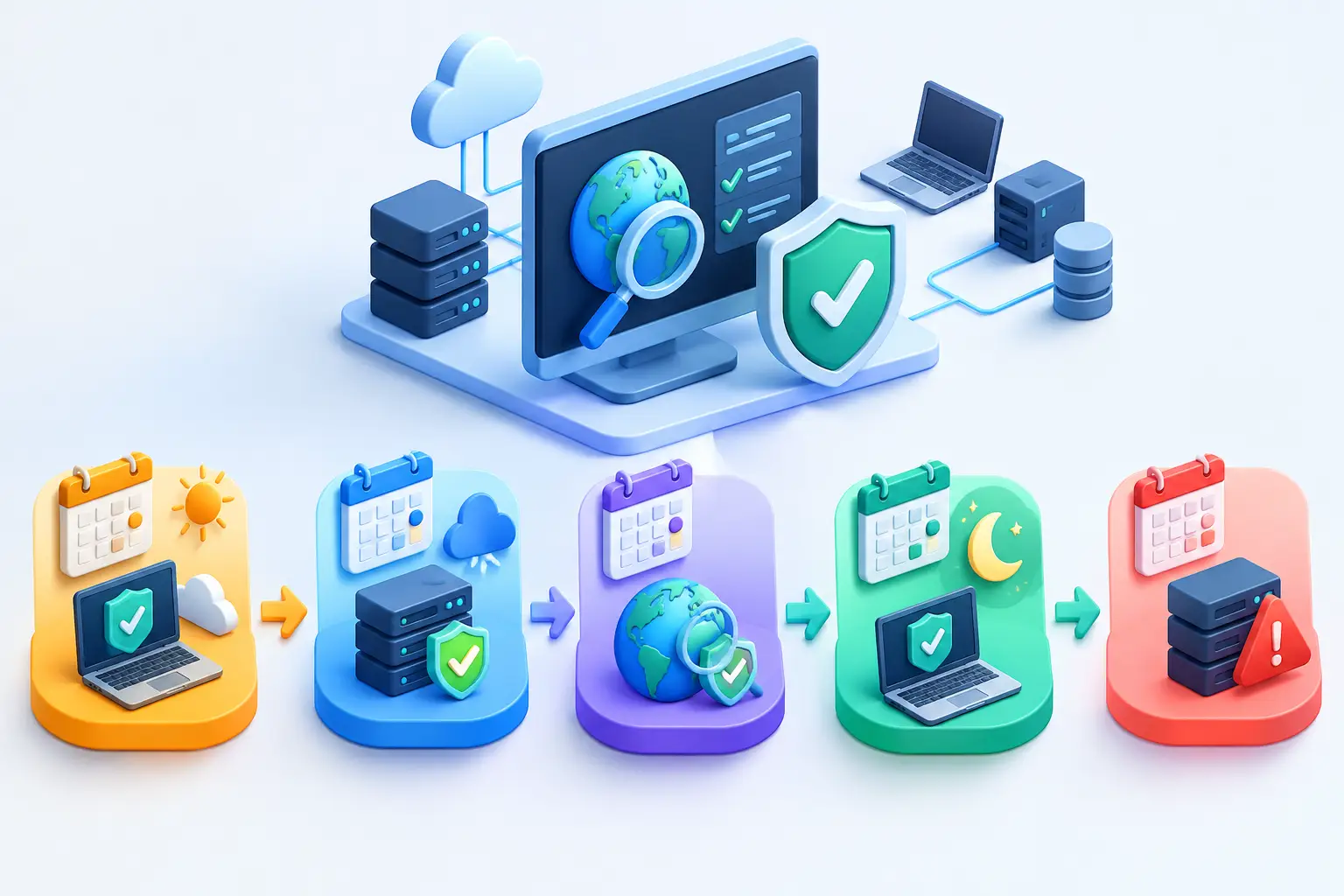
A practical schedule uses layers. Continuous monitoring detects change and exposure as they occur. Recurring vulnerability scans identify known weaknesses. Periodic expert reviews provide context, validation, and a deeper assessment of how vulnerabilities could affect the business.
Continuous monitoring for internet-facing changes
Monitor your public attack surface continuously, or as close to continuously as your monitoring platform supports. This includes new domains and subdomains, DNS changes, certificate activity, open ports, newly discovered services, reputation concerns, and changes in email security configuration.
Continuous monitoring is especially valuable because unauthorized or forgotten assets are often the problem. An organization cannot remediate a system it does not know exists. Asset discovery should alert the responsible team when a new service appears, a domain approaches expiration, or a public-facing configuration changes unexpectedly.
For small and mid-sized businesses, this does not require a large internal security operations center. It requires a defined monitoring process, clear ownership, and an escalation path for findings that need immediate attention.
Weekly scans for critical public systems
Organizations should scan critical internet-facing assets at least weekly. This category commonly includes customer portals, e-commerce sites, primary web applications, VPN gateways, remote desktop exposure, production APIs, and systems that process sensitive customer, financial, or regulated information.
Weekly scanning provides a reasonable balance between visibility and operational workload for many businesses. It allows teams to identify new vulnerabilities, verify that remediation is holding, and respond to changes in externally exposed services without waiting for a monthly reporting cycle.
If a critical system is under active development, receives frequent updates, or has a history of configuration drift, increase the frequency. Daily authenticated or targeted vulnerability scanning may be appropriate when it can be performed safely and without affecting application performance.
Monthly scans for lower-change assets
Stable external assets with lower business impact may be scanned monthly. Examples can include informational websites, older systems with limited functionality, or public services that do not handle sensitive data. Monthly scanning is not a reason to ignore these assets. Attackers often use lower-value systems as an entry point, a phishing resource, or a source of intelligence about the organization.
The key distinction is risk. A brochure site with no login function and limited integrations does not demand the same cadence as a public customer portal. Still, its domain configuration, TLS certificate, content management software, web server, and third-party components need recurring review.
Scan after every meaningful change
A scheduled cadence should never be the only trigger. Scan relevant external assets after a meaningful change, including a website release, cloud migration, firewall modification, DNS update, new SaaS integration, email platform transition, acquisition, or deployment of a new remote access tool.
This change-based scan is one of the most effective ways to reduce preventable exposure. It validates that the deployed system matches the intended design and that no unexpected services, weak configurations, or outdated components were introduced during implementation.
Build a schedule around your business reality
The best scanning schedule is based on risk, not a generic calendar. Start by maintaining an accurate inventory of all externally accessible assets. Record the business owner, technical owner, purpose, data sensitivity, hosting environment, and expected exposure for each one.
Then classify assets according to their potential impact. A public application that supports customer accounts should receive greater scrutiny than a static campaign page. A mail server with weak authentication controls may create significant phishing and spoofing risk even if it does not appear to be a conventional web application. A forgotten development subdomain can be high risk because it may lack the controls applied to production systems.
A useful operating model has three parts: continuous attack surface monitoring, recurring vulnerability scanning, and scheduled security reviews. Continuous monitoring tells you what has changed. Vulnerability scans identify issues that need investigation. Security reviews determine which findings are truly urgent, what remediation is required, and whether recurring issues point to a wider control gap.
Do not confuse scanning with remediation
Scanning more frequently does not automatically improve security. If findings remain unassigned, unvalidated, or unresolved, the organization is simply collecting evidence of risk. The remediation workflow matters as much as the scan schedule.
Each finding should have a documented severity, affected asset, owner, recommended action, target date, and verification step. Critical findings, such as exposed administrative access, known exploitable vulnerabilities, weak email authentication, or expired certificates, should follow an accelerated response process. Lower-priority findings can be addressed through planned maintenance, provided they are tracked and reassessed.
False positives and duplicate findings also require attention. Automated tools can identify a possible issue without proving that it is exploitable in your environment. Review prevents teams from wasting time on noise while ensuring real weaknesses are not dismissed. The goal is a prioritized remediation plan, not an overwhelming list of technical alerts.
When to increase scanning frequency
Certain events should prompt a more aggressive cadence. Increase monitoring and scanning when your organization is deploying new applications, moving infrastructure to the cloud, integrating a third party, or expanding remote access. The same applies after a security incident, a major vulnerability disclosure affecting your technology stack, or evidence that attackers are targeting your industry.
Compliance obligations may also influence frequency. Frameworks and contractual requirements often call for regular vulnerability assessments, documented remediation, and evidence of ongoing oversight. Meeting a minimum requirement is useful, but it should not become the sole standard. A monthly scan may satisfy a policy while leaving fast-changing internet-facing assets exposed for too long.
Seasonality matters as well. Retailers may increase coverage before high-volume sales periods. Professional services firms may do the same before tax deadlines. Any period when systems are more heavily used, more visible, or less available for emergency maintenance deserves additional preparation.
Turn scan results into accountable security operations
External scanning works best when reporting is designed for decisions. Technical teams need details about affected hosts, services, configurations, and remediation steps. Business leaders need to know whether exposure is increasing, which issues require investment, who owns the next action, and whether risk is being reduced over time.
A centralized dashboard and recurring reports can make this process manageable. They provide a record of discovered assets, open findings, remediation status, overdue actions, and trend data. This visibility helps organizations move from reactive cleanup to governed security operations.
The right question is not whether your business scans often enough on paper. It is whether new external exposure is identified quickly, serious findings are assigned without delay, and remediation is verified. Establish that discipline, and your scanning schedule becomes a practical defense rather than another compliance task.