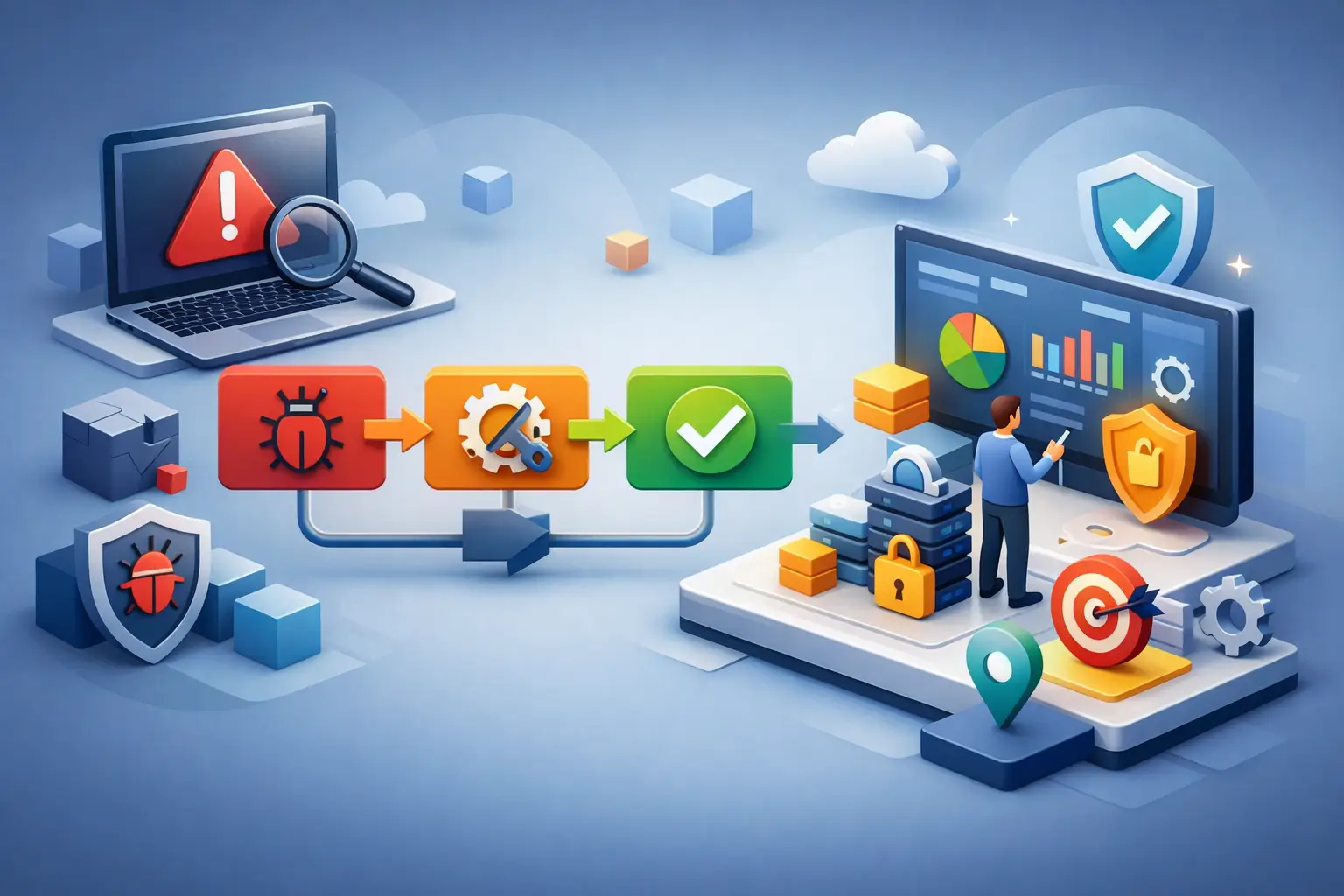
How Vulnerability Management Software Drives Action
A critical vulnerability in a public-facing application does not become less dangerous because it appears in a long scan report. For many businesses, the real challenge is turning that finding into a verified fix before it becomes an incident. Vulnerability management software provides the structure to identify weaknesses, understand their business impact, assign remediation work, and maintain visibility after the initial assessment.
That distinction matters for organizations managing websites, domains, email environments, cloud services, and network infrastructure with limited internal security resources. A scan can reveal exposure. A disciplined management process determines whether that exposure is reduced.
What Vulnerability Management Software Should Do
Effective vulnerability management is more than a recurring scan schedule. The software should create a repeatable operating process that connects asset discovery, technical findings, risk prioritization, remediation planning, and ongoing verification.
First, it needs to establish what the business is responsible for protecting. Unknown subdomains, forgotten web applications, outdated external services, and unmanaged network devices can create risk outside the assets an IT team actively tracks. If an asset is not visible, it is unlikely to be properly assessed or remediated.
Next, the platform must translate findings into useful decisions. A list of CVEs, severity scores, and affected hosts may be valuable to security specialists, but it does not tell an operations leader what should happen first. Context changes the priority. A medium-severity weakness on an internet-facing login portal may require faster action than a higher-severity issue on an isolated, retired system.
The final requirement is accountability. Findings need owners, target dates, status tracking, evidence of remediation, and a way to confirm that the weakness is no longer present. Without those controls, vulnerability data becomes a backlog that grows faster than the team can manage it.
The Vulnerability Management Workflow That Reduces Risk
A practical program follows a cycle rather than treating security assessments as one-time events. Each stage has a distinct purpose, and weak performance in one stage affects every stage that follows.
Identify the full attack surface
Begin with a current inventory of domains, IP addresses, web applications, cloud instances, email systems, and network assets. This should include production systems as well as legacy services, staging environments, third-party integrations, and subsidiaries that may use separate infrastructure.
External exposure deserves special attention. Attackers often start with what they can see from the internet: an exposed administrative panel, a misconfigured DNS record, an expired certificate, an unpatched web component, or a domain that resembles a legitimate brand. Continuous domain and exposure monitoring helps detect these changes as the environment evolves.
Assess and validate findings
Scanners are essential, but they are not perfect. They can produce duplicate findings, incomplete context, and occasional false positives. High-value vulnerabilities should be reviewed with enough technical analysis to establish whether the affected service is active, reachable, exploitable, and relevant to the organization.
Validation does not mean waiting for absolute certainty before acting. It means avoiding wasted effort while ensuring serious issues are not buried under low-value alerts. For small and mid-sized businesses, expert review can be particularly valuable when internal teams do not have dedicated security analysts available to interpret scan results.
Prioritize by business exposure
Severity ratings are a starting point, not a remediation plan. Prioritization should consider whether the asset is internet-facing, what data it handles, whether compensating controls exist, how easily the issue can be exploited, and the likely operational impact of a compromise.
A clear priority model commonly separates urgent fixes from planned remediation. An actively exposed critical vulnerability may require immediate containment, such as restricting access or disabling a service, before a permanent patch can be applied. Lower-risk issues can be scheduled, but they should still have an owner and a documented due date.
Remediate with clear instructions
The most useful reports do not stop at identifying a weakness. They explain the affected asset, the observed condition, the potential impact, and the recommended corrective action. That may mean applying a vendor patch, removing an unnecessary service, updating a configuration, strengthening access controls, or replacing unsupported software.
Remediation can involve trade-offs. Patching a production application may create downtime or compatibility concerns, while delaying a patch can extend exposure. A good process records that decision, applies temporary safeguards where appropriate, and sets a realistic deadline for the permanent correction.
Verify and monitor
A finding should not be marked resolved solely because someone states that a change was made. Rescanning, configuration review, or other validation should confirm that the vulnerability is no longer detectable and that the change did not create a new issue.
Monitoring then continues. New vulnerabilities emerge, software versions change, domains are added, and configurations drift. Continuous oversight turns security from a periodic scramble into a managed operating function.
Features to Look for in Vulnerability Management Software
The right platform depends on the organization’s environment, regulatory obligations, and internal capabilities. A business with a small external footprint may need focused web and domain monitoring, while a company with distributed offices and internal systems may need broader network coverage. In either case, several capabilities have a direct impact on day-to-day security operations:
- Asset and exposure visibility that identifies public-facing systems and tracks changes across domains, web applications, and network infrastructure.
- Risk-based prioritization that combines severity with asset criticality, internet exposure, exploitability, and business context.
- Actionable remediation guidance that gives administrators clear next steps instead of only technical identifiers.
- Centralized dashboards and reporting that show open findings, remediation progress, trends, exceptions, and evidence for leadership or compliance reviews.
- Continuous monitoring and reassessment that detects new weaknesses and verifies whether reported issues have been resolved.
- Role-based administration and ownership tracking so findings reach the right people without exposing unnecessary information to every user.
Reporting deserves more attention than it often receives. IT teams need technical detail, while executives and compliance stakeholders need a concise view of risk, progress, and unresolved exposure. A platform should support both audiences without forcing staff to rebuild the same information manually in spreadsheets and presentations.
Where Software Alone Falls Short
Vulnerability management software can improve visibility and discipline, but it cannot make business decisions on its own. It cannot determine whether a legacy application can be safely patched this week, whether a vendor owns a specific system, or whether a compensating control is sufficient for a temporary exception.
That is why the strongest programs combine platform-based monitoring with security expertise. Analysis helps separate urgent risks from noise, remediation planning accounts for operational constraints, and periodic review ensures that accepted risks do not become forgotten risks. For organizations without a full internal security team, this combination can provide both practical oversight and a documented path to improvement.
Building a Program That Teams Can Sustain
Start with a manageable scope. Prioritize public-facing web assets, external domains, email infrastructure, critical applications, and systems that store sensitive business or customer data. Establish a baseline assessment, then assign ownership for every material finding. An unassigned issue is not a managed issue.
Set remediation expectations that fit the level of risk. Critical internet-facing findings may need same-day review and rapid containment. Moderate findings may follow a scheduled maintenance window. The exact timelines depend on the business, but the rules should be documented and consistently applied.
Finally, review trends rather than only individual alerts. Are the same configuration errors recurring? Are patch timelines improving? Are new domains appearing without security review? These patterns reveal whether the organization is reducing risk at its source or repeatedly treating the same symptoms.
FortifyNET approaches vulnerability management as an ongoing security discipline: assess the environment, prioritize what matters, guide remediation, and keep monitoring the exposure that remains. The goal is not a cleaner report. It is a security posture that can be understood, managed, and strengthened over time.