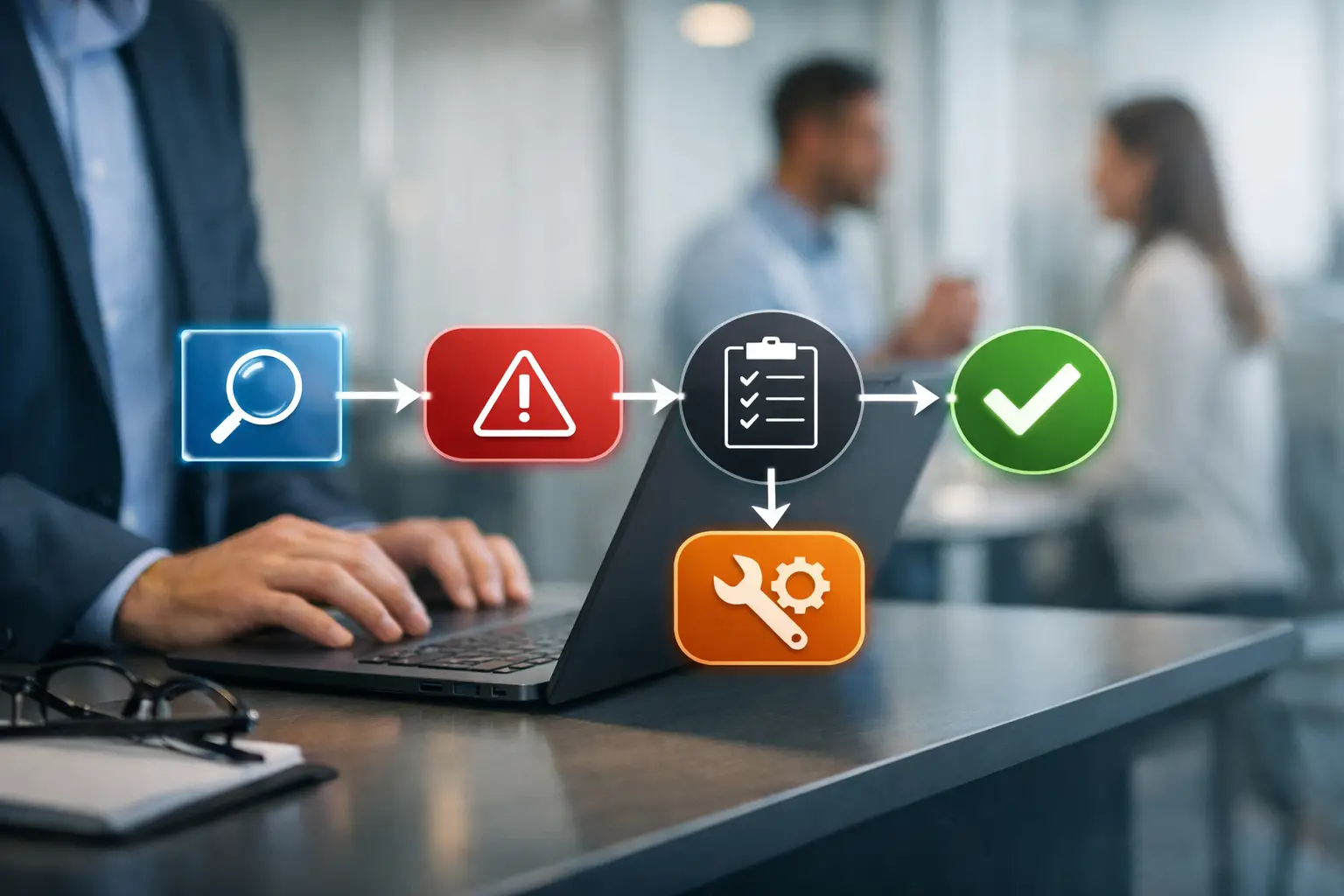
Managed Vulnerability Monitoring That Drives Action
A critical finding on a public-facing server is not automatically a security program. Neither is a monthly scan that produces a long spreadsheet nobody has time to interpret. Managed vulnerability monitoring turns vulnerability data into a disciplined operating process: identify exposure, understand business impact, remediate the right issues, and verify that risk has been reduced.
For small and mid-sized organizations, that process matters because the attack surface rarely stays still. Domains are added, web applications change, cloud settings drift, certificates expire, and new vulnerabilities affect technologies already in use. The question is not whether a scan can find issues. The question is whether your organization can consistently act on what it finds.
What managed vulnerability monitoring actually covers
Managed vulnerability monitoring combines recurring technical assessment with expert review, prioritization, reporting, and remediation guidance. It is designed to provide continuous oversight across the assets that attackers can see and target, including websites, web applications, domains, email environments, internet-facing services, and network infrastructure.
The monitoring component detects changes over time. A new exposed service, a missing security header, an outdated software component, or a misconfigured DNS record may not have existed during the last assessment. Ongoing scans help identify that change before it becomes an overlooked weakness.
The managed component is equally important. Raw scanner output can overwhelm an internal IT team, especially when findings include duplicate alerts, low-value informational notices, or issues that require context to assess accurately. Expert analysis separates likely business risks from noise and translates technical findings into a practical remediation plan.
This does not mean every finding receives the same urgency. A vulnerability affecting an isolated internal test system should not necessarily be handled like a critical flaw on a production customer portal. Effective monitoring accounts for exposure, exploitability, asset importance, available compensating controls, and the sensitivity of data involved.
Why one-time assessments leave gaps
A point-in-time vulnerability assessment can be valuable. It establishes a baseline, exposes existing weaknesses, and helps leaders understand where security controls need attention. But it captures only one moment in an environment that continues to change.
A web development release can introduce an insecure configuration after an audit is complete. A newly disclosed vulnerability can affect a system that was considered secure last week. A domain renewal issue or an email authentication change can create exposure without triggering a traditional network scan.
This is where a recurring model provides operational value. Rather than treating security as a project that ends when a report is delivered, managed monitoring creates a cycle of assessment, action, validation, and reporting. It gives administrators a reliable way to see what changed and leaders a documented record of how risks are being addressed.
For organizations with limited internal security resources, this continuity is often more useful than purchasing increasingly complex tools. A platform can generate alerts, but it cannot by itself determine who owns remediation, what should be fixed first, or whether a proposed change creates a business disruption. Those decisions require a structured workflow and informed oversight.
From findings to a remediation plan
The most useful vulnerability report does more than assign a severity label. It should help the responsible team answer four practical questions: What is affected? Why does it matter? What action should be taken? How will we know the issue is resolved?
A strong managed service begins by maintaining an accurate inventory of monitored assets. This includes known domains and IP addresses, but it should also account for web applications, exposed subdomains, email-related records, and external services that support business operations. If an asset is unknown or excluded, it cannot be meaningfully monitored.
Findings should then be prioritized according to real-world risk. Common Vulnerability Scoring System scores are useful inputs, but they are not a complete decision model. A high-severity issue may be less urgent if it is unreachable from the internet and protected by other controls. Conversely, a moderate configuration issue on a public login page may deserve fast attention because it affects a high-value, exposed asset.
Clear ownership prevents remediation delays
Many vulnerabilities remain open not because the fix is difficult, but because responsibility is unclear. A finding may sit between a web developer, a managed service provider, a cloud administrator, and an internal IT manager. Without an assigned owner and due date, it becomes another line item in a report.
Managed vulnerability monitoring should support clear accountability. Each priority finding needs a designated owner, a recommended remediation path, a target timeline, and a status that can be reviewed. Where remediation requires a maintenance window or vendor coordination, that dependency should be documented rather than treated as an unexplained exception.
Validation matters as much as discovery
Closing a ticket is not proof that an issue has been corrected. Configuration changes can fail, patches may not apply properly, and a vulnerable component can remain accessible through another path. Rescanning and validation confirm whether the remediation worked.
That verification step provides confidence to IT teams and evidence for business leaders, customers, auditors, or compliance stakeholders. It also helps identify recurring problems, such as systems that repeatedly fall behind on patches or development processes that reintroduce the same web security weakness.
Monitoring the full external attack surface
A business can have a well-managed internal network and still face material external risk. Attackers commonly begin with the systems that are easy to discover: public websites, remote access portals, exposed administration interfaces, DNS records, and email infrastructure.
Web monitoring should evaluate the technical controls that protect public applications and services. Depending on the environment, this may include software exposure, transport security, certificate status, configuration weaknesses, application security issues, and unnecessary internet-facing services. The goal is not simply to collect technical details. It is to identify exposure that could affect customer data, business continuity, or brand trust.
Domain and email monitoring deserve the same attention. A forgotten subdomain, incorrect DNS configuration, missing email authentication policy, or certificate expiration can create opportunities for phishing, impersonation, service disruption, or unauthorized access. These items are often owned by different teams, which makes centralized visibility especially valuable.
Network monitoring adds another layer by identifying exposed ports, services, and known vulnerabilities across reachable infrastructure. The right scope depends on the organization. A company with a simple hosted website needs a different monitoring plan than a business operating multiple locations, cloud workloads, remote access systems, and customer-facing applications.
What to expect from a managed program
A productive service should begin with onboarding and asset confirmation, not with an assumption that a scan tool has found everything. The provider and customer need a shared view of the environment, including what is in scope, which systems are business-critical, and who should receive alerts and reports.
From there, the program should provide a centralized dashboard or reporting process that shows current risk, open findings, remediation status, and trends over time. Technical teams need enough detail to take action. Executives and compliance stakeholders need a clear view of material exposure, progress, and unresolved exceptions. These are different audiences, and the reporting should support both.
FortifyNET approaches this work as an ongoing security discipline, pairing continuous visibility with clear remediation direction. The objective is not to create more alerts for administrators to manage. It is to establish an operating rhythm that keeps security decisions visible, prioritized, and documented.
There are trade-offs to consider. Continuous monitoring can identify more findings, which may initially increase the workload for a team that has accumulated security debt. Broader coverage also requires careful asset management to avoid scanning systems that are out of scope or missing systems that matter. The answer is not to reduce visibility. It is to build a phased remediation plan that addresses critical exposure first while creating realistic timelines for lower-risk improvements.
Questions to ask before selecting a provider
Before adopting a managed service, ask how findings are prioritized beyond automated severity scores and whether reports include clear remediation guidance. Confirm what assets are monitored, how new domains or services are added, and how often rescans validate completed work.
Also ask how the service handles false positives, exceptions, and findings that cannot be remediated immediately. A mature program documents compensating controls and accepted risks rather than quietly allowing issues to disappear from view. Finally, determine whether the reporting can support the operational and compliance conversations your organization must have.
The right program gives your team more than a list of vulnerabilities. It gives them a repeatable way to make defensible security decisions as your environment changes.