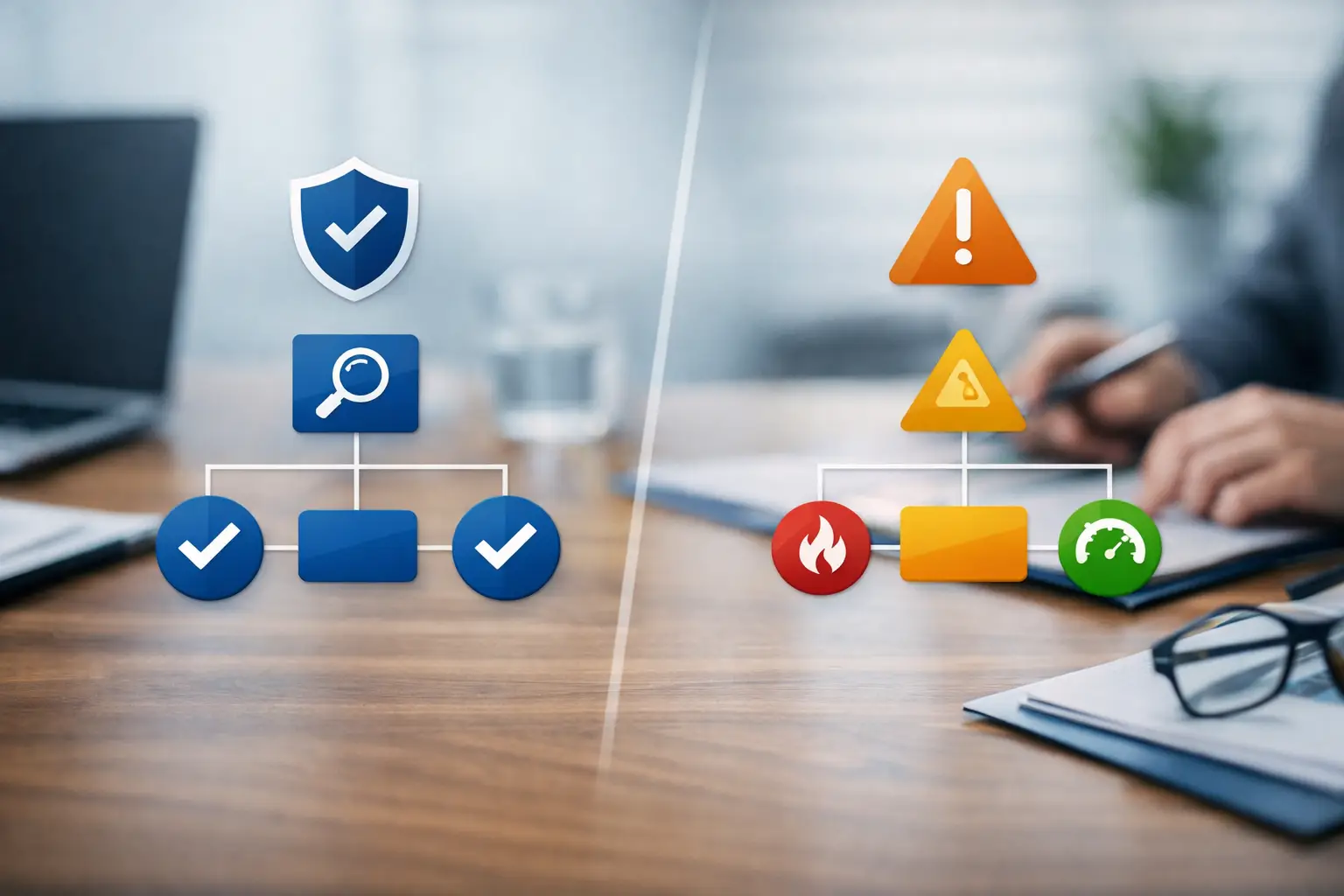
Security Audit vs Risk Assessment Differences
A newly discovered critical vulnerability can demand immediate action. A growing dependency on a cloud provider, a new customer portal, or an upcoming compliance review may require a different kind of decision. That distinction sits at the center of the security audit vs risk assessment question. Both processes improve security posture, but they answer different questions and produce different outcomes.
For business leaders and IT teams, confusing the two can lead to incomplete coverage. An audit may reveal a missing control without explaining the business impact if it remains unresolved. A risk assessment may identify a high-value exposure without verifying whether a specific control is operating as intended. Used together, they create a clearer path from discovery to remediation and ongoing oversight.
What a Security Audit Examines
A security audit is a structured examination of systems, configurations, processes, and controls against defined requirements. Those requirements may come from an internal security policy, a customer contract, an industry framework, or a regulatory obligation. The central question is straightforward: are the required controls present, configured correctly, and operating as expected?
For a business with public-facing assets, an audit may review domain and DNS settings, web application security headers, access controls, patching practices, email authentication, endpoint protections, network segmentation, logging, and incident response documentation. The scope depends on the environment and the standard being measured.
Audits are evidence-driven. A reviewer checks configurations, examines records, validates permissions, and documents exceptions. The outcome is typically a report that identifies compliant areas, control gaps, supporting evidence, and recommended corrective actions. This makes an audit especially useful when an organization needs documented accountability.
A payment processor, for example, may need evidence that privileged access is restricted and reviewed. A healthcare-related business may need to demonstrate that systems handling sensitive information are governed by appropriate safeguards. Even when no formal regulation applies, an internal audit can establish whether the security practices a business has committed to are actually being followed.
What an audit does not always answer
An audit is not automatically a complete measure of business risk. A control can meet a checklist requirement and still leave the organization exposed to a threat that was not anticipated by the checklist. Conversely, an audit finding may be technically valid but carry limited practical impact in a specific environment.
For example, an audit may flag a missing policy review date or an incomplete configuration standard. That matters and should be corrected, but it may not be as urgent as an exposed administrative interface or a domain vulnerable to takeover. Audit findings require prioritization, which is where risk assessment adds necessary context.
What a Risk Assessment Examines
A risk assessment identifies what could harm the business, how likely that harm is to occur, and what the consequences would be. It considers assets, threats, vulnerabilities, existing safeguards, and business impact. Instead of asking whether a control meets a requirement, it asks where the organization is most exposed and what should be addressed first.
The process begins by identifying assets that matter: customer data, email systems, production websites, payment workflows, cloud environments, intellectual property, administrative accounts, and third-party connections. Teams then evaluate credible threat scenarios. Could a phishing campaign compromise an executive mailbox? Could an unpatched web application expose customer records? Could a DNS misconfiguration interrupt critical services?
Risk is commonly evaluated through likelihood and impact. Likelihood reflects how feasible or probable a threat scenario is. Impact considers financial loss, operational disruption, legal exposure, customer trust, and recovery effort. The result is a prioritized view of exposure rather than a simple inventory of technical issues.
A risk assessment is particularly valuable when resources are limited. Most small and mid-sized businesses cannot remediate every finding at once. Risk-based prioritization helps teams focus on the issues that create the greatest potential harm, such as internet-facing vulnerabilities, weak identity controls, unprotected email domains, or unsupported systems connected to business-critical operations.
Risk changes as the business changes
Risk assessments should not be treated as one-time exercises. A business can introduce new risk by launching a web application, adding a SaaS platform, acquiring another company, granting remote access to a vendor, or changing how customer data is stored. Threat activity also changes. A risk that was acceptable six months ago may deserve immediate attention after a new exploit becomes widely available.
This is why continuous monitoring matters. Ongoing visibility into domains, certificates, exposed services, email controls, and changing vulnerabilities gives organizations a way to detect material changes between formal assessment cycles.
Security Audit vs Risk Assessment: The Practical Difference
The simplest distinction is that an audit measures conformance, while a risk assessment measures exposure and priority.
A security audit compares the current state of controls with a defined baseline. It is well suited to compliance preparation, customer assurance, governance reviews, and validation of internal security requirements. Its output helps answer, “Can we prove that our controls are in place?”
A risk assessment evaluates the business consequences of threats and weaknesses. It is well suited to security planning, budget decisions, remediation sequencing, and executive reporting. Its output helps answer, “What could materially affect our business, and what should we do first?”
The two processes may uncover some of the same findings, but they frame them differently. Consider multi-factor authentication for administrator accounts. An audit may verify whether the control is required and consistently enforced. A risk assessment considers the likelihood of account compromise, the systems those administrators can access, and the potential damage from a successful attack. The audit validates the control. The assessment explains why its failure matters.
When to Use an Audit, a Risk Assessment, or Both
Use a security audit when the organization needs objective evidence against a standard. This may include preparing for a compliance review, responding to a customer security questionnaire, validating a new policy, or checking whether a remediation program was completed correctly.
Use a risk assessment when leadership must make informed choices about security priorities. It is useful before major technology changes, after a significant incident, during annual planning, when entering a new market, or when the business lacks a clear view of its most consequential exposures.
In most cases, both are needed. A risk assessment helps determine which safeguards deserve the most urgent investment. An audit confirms that those safeguards have been implemented and maintained. This sequence prevents teams from treating compliance as a substitute for security or treating risk discussions as a substitute for evidence.
There are trade-offs. A deeply scoped audit can consume time and require extensive evidence collection. A broad risk assessment can become too theoretical if it is not grounded in current technical findings. The right approach depends on the organization’s size, regulatory obligations, asset inventory, and tolerance for disruption. A focused assessment of external attack surface may be the right starting point for a growing digital business, while a mature organization may require recurring audits across multiple environments.
Turning Findings Into Remediation Work
The value of either process depends on what happens after the report is delivered. Findings should be translated into an owned remediation plan with priorities, deadlines, responsible parties, and verification steps. A report that lists vulnerabilities without a practical plan creates awareness, not protection.
Start by separating immediate threats from longer-term improvements. A publicly exposed service with a known critical vulnerability, an expired certificate, or missing email authentication should receive rapid attention. Other work, such as updating standards, improving asset inventories, or refining access review procedures, may require a scheduled program with executive support.
Each remediation item should identify the affected asset, the security issue, the business impact, the recommended action, the owner, and the expected completion date. Once resolved, the change should be validated. Closing a ticket is not the same as confirming that a vulnerability is no longer exposed or that a control operates consistently.
FortifyNET supports this operational model by connecting security analysis with actionable remediation planning, structured reporting, and continuous monitoring. The goal is not simply to generate more alerts. It is to give administrators and decision-makers a clear record of what needs attention, why it matters, and whether corrective action has reduced the exposure.
Build a Security Program That Can Adapt
Security audits and risk assessments are most effective when they feed an ongoing security discipline. Maintain an accurate inventory of public-facing assets. Reassess risk when systems, vendors, or business processes change. Review control performance on a planned schedule. Monitor for newly exposed vulnerabilities and configuration drift between formal reviews.
The practical goal is not perfect documentation or a risk register that never changes. It is a security program that can identify meaningful exposure early, assign responsibility clearly, and verify that remediation holds over time. When your next audit or assessment arrives, the work should confirm a process already in motion - not reveal a problem that has been waiting unnoticed.