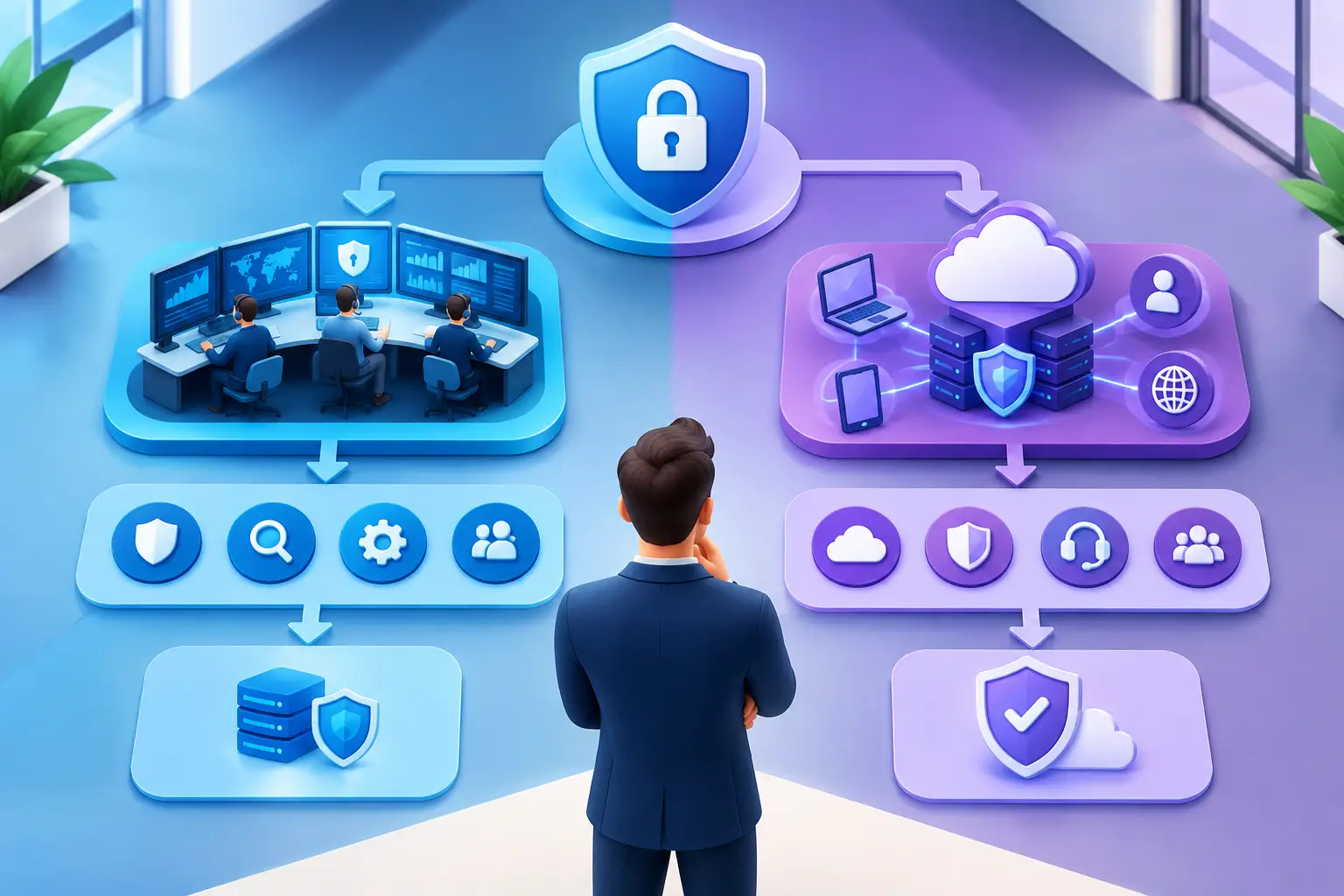
SOC vs MSSP: Which Security Model Fits Your Business?
A critical vulnerability on a public-facing application does not wait for the next quarterly IT meeting. Someone needs to see it, determine whether it creates real exposure, assign remediation, and confirm the fix. That operational reality is at the center of the SOC vs MSSP decision.
For small and mid-sized businesses, the question is rarely whether security matters. The question is who will provide the visibility, analysis, and follow-through needed to reduce risk without building an expensive security operation from scratch. A security operations center and a managed security service provider can both support that goal, but they solve different parts of the problem and require different levels of internal ownership.
SOC vs MSSP: The Core Difference
A SOC, or security operations center, is a security function. It combines people, processes, and technology to monitor security events, investigate suspicious activity, manage incidents, and improve detection over time. A SOC may be operated internally, outsourced, or delivered as part of another security service.
An MSSP, or managed security service provider, is an external company that delivers ongoing security services. Those services may include log monitoring, endpoint management, firewall oversight, vulnerability scanning, email security, compliance reporting, incident support, or a managed SOC capability.
That distinction matters because SOC vs MSSP is not always a strict either-or choice. An organization can build an internal SOC. It can retain an MSSP without receiving 24/7 threat monitoring. Or it can engage an MSSP that operates a SOC on its behalf. The right decision depends on the business's attack surface, compliance obligations, internal skills, and ability to act on findings.
What an Internal SOC Requires
An internal SOC gives an organization direct control over its security operations. The team can tailor monitoring rules to its applications, infrastructure, users, and business processes. Analysts can work closely with IT, development, legal, and leadership, often improving context during an investigation.
That control comes with a substantial operating commitment. A meaningful SOC requires more than a security information and event management platform. It needs trained analysts, documented escalation procedures, detection engineering, asset inventory discipline, alert tuning, incident response playbooks, and management reporting. If the organization promises around-the-clock coverage, it also needs enough staffing to prevent gaps caused by shifts, vacations, turnover, and alert fatigue.
For a larger company with complex infrastructure, mature IT operations, regulated data, and a dedicated security budget, building a SOC can be justified. The organization may need full authority over how data is collected, how incidents are investigated, and how security controls are prioritized.
For many growing businesses, however, the challenge is not purchasing a monitoring tool. It is sustaining the people and processes around it. An understaffed SOC can create a false sense of security: alerts are generated, but no one consistently validates, prioritizes, and resolves them.
What an MSSP Provides
An MSSP extends a business's security capacity through an external team and established service processes. Rather than recruiting a full internal security operations staff, the customer receives agreed-upon monitoring, reporting, management, and escalation services.
The value is often speed to coverage. An MSSP may already have analysts, monitoring infrastructure, threat intelligence sources, and service workflows in place. This can help a business gain ongoing oversight sooner than it could by designing every capability internally.
The trade-off is that service quality varies significantly. Some providers focus primarily on managing tools. Others deliver active analysis and documented recommendations. Some provide 24/7 alert triage, while others operate during defined business hours. A provider may notify the customer of a potential issue but leave investigation and remediation almost entirely to the internal team.
Before selecting an MSSP, clarify exactly what happens after a finding is generated. Ask who validates the issue, how severity is determined, what evidence is included, who receives the alert, expected response times, and whether remediation guidance is part of the service. A dashboard full of alerts is not the same as operational security oversight.
Compare the Operating Models That Matter
The most useful comparison is not internal team versus outside vendor. It is responsibility versus capability. Your business should know who owns each step from detection through closure.
Visibility and monitoring
An internal SOC can integrate deeply with custom applications, cloud environments, network devices, identity systems, and business workflows. It can adjust its monitoring as the environment changes, assuming the team has the time and expertise to do so.
An MSSP can provide broad monitoring coverage efficiently, especially for standard infrastructure and security tools. For organizations with public domains, websites, email environments, and distributed cloud assets, an MSSP can also help establish continuous visibility where internal teams have limited time. The key is confirming which assets, logs, and exposures are actually included in scope.
Response and remediation
A SOC may have the fastest path to internal action because analysts work directly with system owners. Yet speed depends on authority. If security staff cannot require a patch, disable an account, or escalate a business risk to leadership, even an internal SOC can stall.
An MSSP can identify and escalate threats quickly, but the customer usually retains responsibility for business decisions and many remediation actions. This is not necessarily a weakness. External analysts can provide independent assessment and clear priorities, while internal IT teams make changes with knowledge of operational dependencies. The arrangement works best when both sides use defined escalation paths and remediation owners.
Cost and staffing
Internal SOC costs include salaries, training, turnover, platforms, integrations, and management time. These costs are often underestimated because security work is distributed across IT, engineering, compliance, and leadership.
An MSSP shifts much of that operating cost into a recurring service fee. It can be more predictable, but it is not automatically less expensive in every case. Companies with large, highly specialized environments may eventually find internal investment more economical or strategically necessary. Smaller organizations generally gain more by paying for targeted capabilities they can use immediately.
Control and context
Internal teams possess institutional knowledge. They know which systems are business-critical, which changes are scheduled, and which users require unusual access. That context can improve triage and reduce unnecessary disruption.
External providers need to be given that context through onboarding, asset inventories, contact lists, and recurring service reviews. A strong MSSP relationship is not hands-off. It requires governance from the customer, including regular review of findings, asset changes, risk trends, and outstanding remediation work.
How to Choose Between a SOC and an MSSP
Start with the risks you need to manage, not the technology you want to buy. If your business has a small IT team, a growing number of public-facing assets, limited security expertise, and no ability to staff continuous monitoring, an MSSP or managed monitoring service is usually the more practical starting point.
If you operate a complex environment with high transaction volumes, sensitive data, stringent regulatory demands, and an established security organization, an internal SOC may offer the control and specialization you need. Even then, an MSSP can supplement coverage for specific areas such as vulnerability management, managed email monitoring, or after-hours alerting.
Use these questions to make the decision concrete:
- Do we have a current inventory of domains, applications, networks, cloud services, and email systems?
- Can qualified staff monitor and investigate security events consistently, including outside normal business hours?
- Do we have documented owners and timelines for remediating critical findings?
- Are our reports useful to leadership, auditors, and the teams responsible for corrective action?
- Do we need a provider to operate tools, analyze risk, guide remediation, or all three?
The answers reveal whether the central problem is visibility, expertise, staffing, response authority, or governance. Those are different gaps, and they should not be addressed with a one-size-fits-all service package.
Build Security Operations Around Outcomes
Whether you choose a SOC, an MSSP, or a blended model, measure the program by outcomes. Critical exposures should be identified quickly, findings should be understandable to decision-makers, remediation should have a named owner, and recurring reports should show whether risk is being reduced.
This is where continuous monitoring becomes more valuable than a one-time assessment. A point-in-time scan can identify vulnerabilities, but assets change, software updates introduce new issues, domains are added, and email configurations drift. Ongoing oversight gives the business a way to detect those changes and maintain accountability.
FortifyNET approaches this operational need through security analysis, prioritized remediation planning, and continuous monitoring across web and network environments. The goal is not to create more alerts. It is to give administrators and leaders a clear view of what requires action and a disciplined process for closing the gap.
Choose the model that gives your business the clearest path from detection to remediation. Security improves when every finding has context, ownership, and a verified next step.